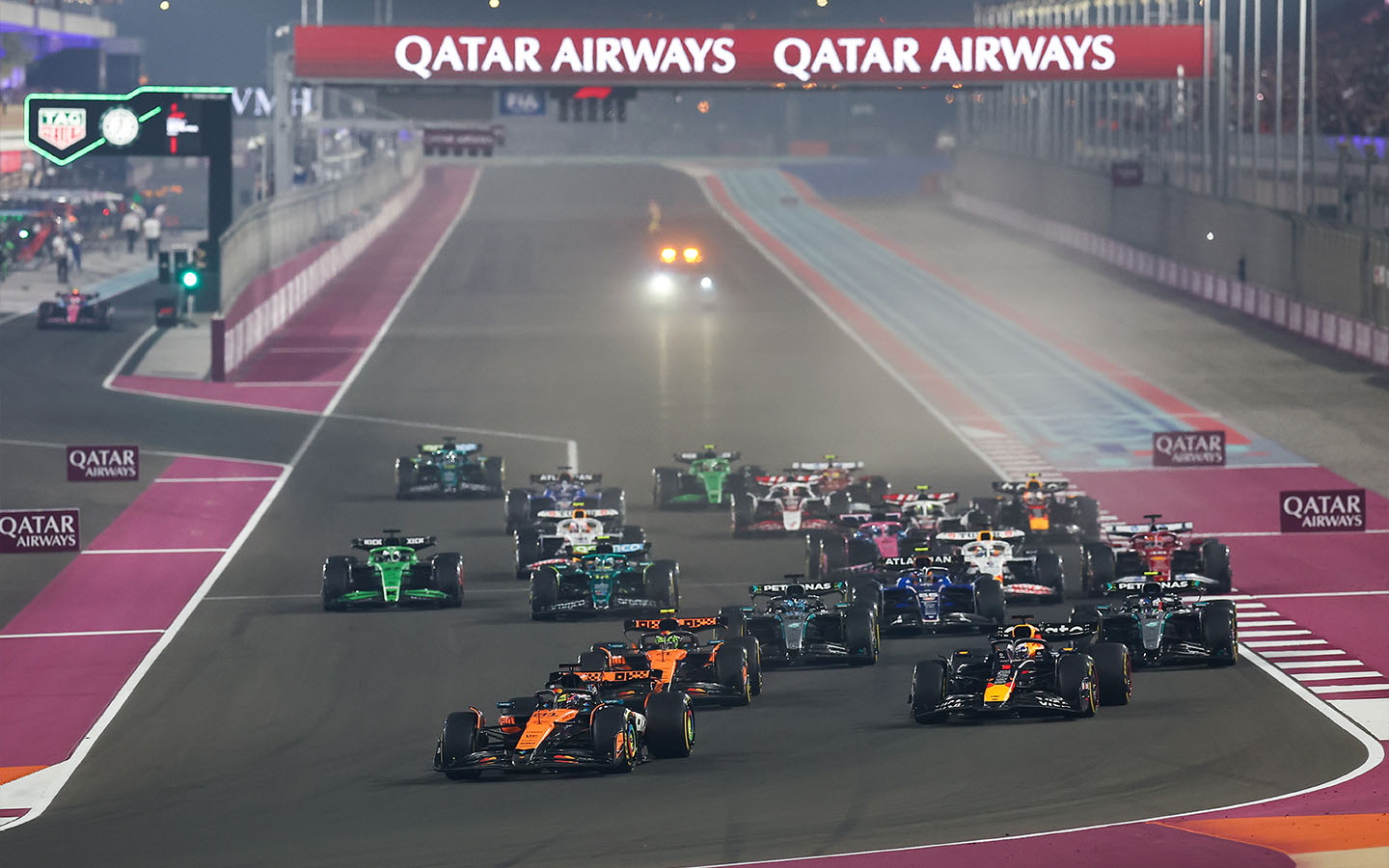
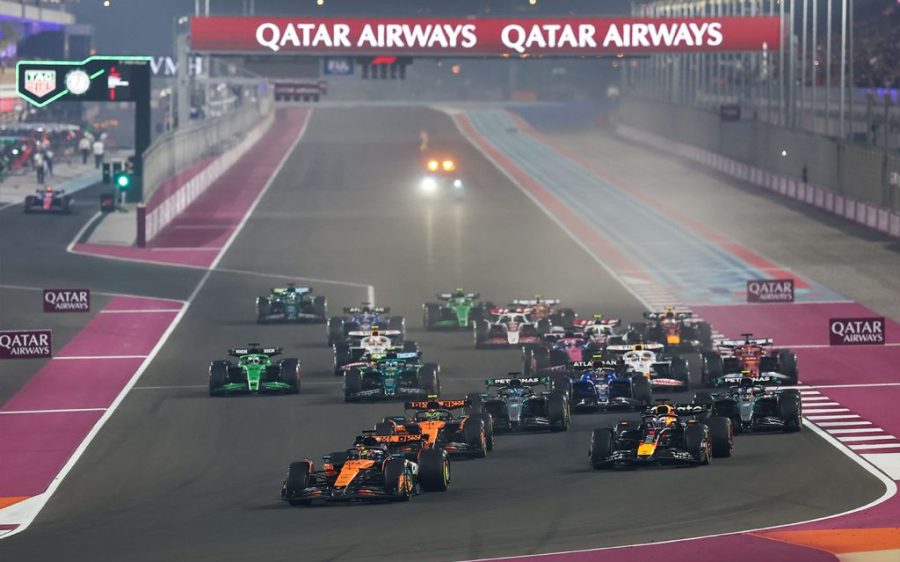
From the muggy streets of Singapore to the arid boulevards of Las Vegas, Formula 1 (F1) is international in every sense of the word, with the current calendar consisting of 24 races spanning 21 countries and regions.
Although Macao has never served as an F1 host, calls have been made over the years for the city to join the ranks. One proponent included Max Mosley, the former president of motorsports’ governing body, the Fédération Internationale de l’Automobile (FIA). He pitched the idea to the then-head of the Macau Grand Prix organising committee, João Manuel Costa Antunes, after visiting the city’s Guia Circuit in 1993.
The proposal ultimately fell flat, as Antunes made it clear that Macao’s Guia Circuit would be unable to accommodate F1 vehicles due to the narrow nature of the track, especially around the infamous Melco hairpin, which has a width of just seven metres.
Still, the dream of bringing the world’s highest motorsports class to the SAR has persisted, with former F1 owner Bernie Ecclestone lobbying for such races in 2000 before Antunes once again highlighted that it would not be feasible under the existing circuit.
[See more: ‘Nothing prepares you for Macao,’ says FIA F4 World Cup winner Jules Roussel]
A more recent attempt to draw attention to the issue occurred in December 2025, when lawmaker Angela Leong urged the Macao government to consider the possibility of staging an F1 event using the roomier roads of Cotai, citing F1 champion Lewis Hamilton as saying that Macao was an ideal place for an F1 night race.
Leong argued that such a championship could be organised alongside concerts, cultural exhibitions and other large-scale offerings, creating a high-profile event beneficial to the local tourism and nighttime economy in a way not unlike the races offered in Las Vegas and Singapore. On top of this, the legislator brought up the idea of a crossboundary Macao-Hengqin circuit capable of hosting international competitions.
The response from Macao’s secretary for culture and social affairs, O Lam was ambivalent. “I think this might be a long-term plan, but it’s not impossible,” she said. “We may need some time for assessment.”
What would it take to hold an F1 in Macao?
Supposing Macao was serious about hosting F1 races, it would need to back up its words with concrete action, says Matthew Marsh, a motorsports consultant and former race car driver.
“You hire the people [e.g. consultants, designers and engineers]…you spend the money, you do it properly, and then you go to F1 and say, ‘can we have a conversation?’” the F1 analyst notes. “That’s a significant investment in time and money, but that’s when you get taken seriously.”
Glenn McCartney, an associate professor in integrated resort and tourism management at the University of Macau, agrees that any proposal to stage an F1 Grand Prix on the Cotai Strip needs to be underpinned by empirical research and clear objectives. He highlights the need to assess both the positives and negatives of such an event, including the displacement of visitors due to the disruption caused by the race.
“Displacement means it might impact gaming revenue,” he notes. “It might impact visitors who don’t come because of the noise or just don’t come that weekend.”
As for examples of best practice that Macao could look to when preparing for an F1 application, Marsh points to the Thai government’s attempt as “exactly the right way” to approach such an undertaking. The Southeast Asian nation’s efforts to stage an F1 race in Bangkok can be traced as far back as 1939, although its most recent attempt dates back in April 2024 to when ex-Prime Minister Srettha Thavisin suggested hosting a Bangkok Grand Prix to strengthen the country’s tourism sector.
Following Thavisin’s removal in August 2024, his successor, Paetongtarn Shinawatra, doubled down on the idea of an F1 race in Bangkok, assessing the feasibility of such an event by considering areas such as location, infrastructure and investment.
[See more: Here’s what to do during the Macau Grand Prix]
“Before they [the Thai government] went to F1, they’d already done the groundwork, which is expensive,” Marsh notes. “But what it meant was that when they approached F1, they approached them with ‘we’ve done the work’ and ‘we’re serious about this.’”
The effort paid off, as F1 president Stefano Domenicali described Thailand’s F1 plans as “impressive” after discussions with Shinawatra in March 2025. In a post-meeting statement, the F1 boss wrote he was “looking forward to continuing our discussions in the weeks and months ahead.”
Unfortunately, Marsh says the ousting of Shinawatra and her officials in charge of the F1 project in August 2025 has put the prospect of a Bangkok Grand Prix up in the air. Still, Thailand’s preparatory experience could serve as a template for Macao if the city is determined to secure a spot on the calendar.
As the motorsports analyst rightly points out, “you need to think about the economic impact, the positive impact on the citizens, and also potentially the negatives…so that when you present the plan, everyone goes, this is great overall.”
Is an F1 race in Macao really the answer?
As it stands, Marsh questions whether Macao needs to establish an F1 event on the Cotai Strip, especially when the city already has the well-established and iconic Guia Circuit.
For starters, he isn’t convinced the Macao market would reap significant economic benefits from hosting an F1 championship in the same way as Singapore.
The motorsports expert points to Macao’s current tourism market composition, which consists largely of visitors from mainland China, Hong Kong, South Korea, Japan and Southeast Asian nations. Introducing a Macao F1 race, Marsh says, would only “minimally” boost inbound tourism and other business from these locations, as “they already know about Macao.”
Even if the SAR manages to attract a significant number of visitor arrivals via an F1 event, there is still the question of whether the city has enough hotel rooms to accommodate such a massive influx of guests.
McCartney notes that “even with the concerts we have in Macao right now, we just don’t have the hotel inventory, particularly [on] weekends.”
For reference, the 3-day long 2025 Singapore Grand Prix attracted over 300,000 fans versus the roughly 116,000 spectators who attended the 4-day long 2025 Macau Grand Prix. Official data indicates that Macao only had 45,005 guest rooms as of November 2025.
At the same time, the UM professor also sees Macao’s lack of guest rooms as offering further opportunities for collaboration and partnership with neighbouring cities, especially in light of the significant amount of border crossings that already take place during concerts and shows.
Aside from hotel rooms, Marsh points to the cost-benefit imbalance of hosting F1 races in Macao, which would involve the city shouldering hosting and operational fees that could far exceed any potential economic benefits.
[See more: Hana Burton on women in racing, starting late and her dream of Super GT]
“I don’t see the increase in business that Macao would generate by having an F1 Grand Prix being anything more than a pimple on the backside of the costs,” Marsh argues.
Indeed, one estimate made by Forbes back in 2017 put the figure for staging a 10-year F1 Grand Prix at US$1 billion, a sum that hardly seems appealing, especially when the Macao government’s 2026 policy address speaks of the “numerous challenges to Macao’s economic and social development,” including an “international environment [that] is complex and volatile.”
As well, the racing expert questions the idea that an F1 night race in Macao would be “unique,” as other cities, including Singapore and Las Vegas already offer street circuits around casinos.
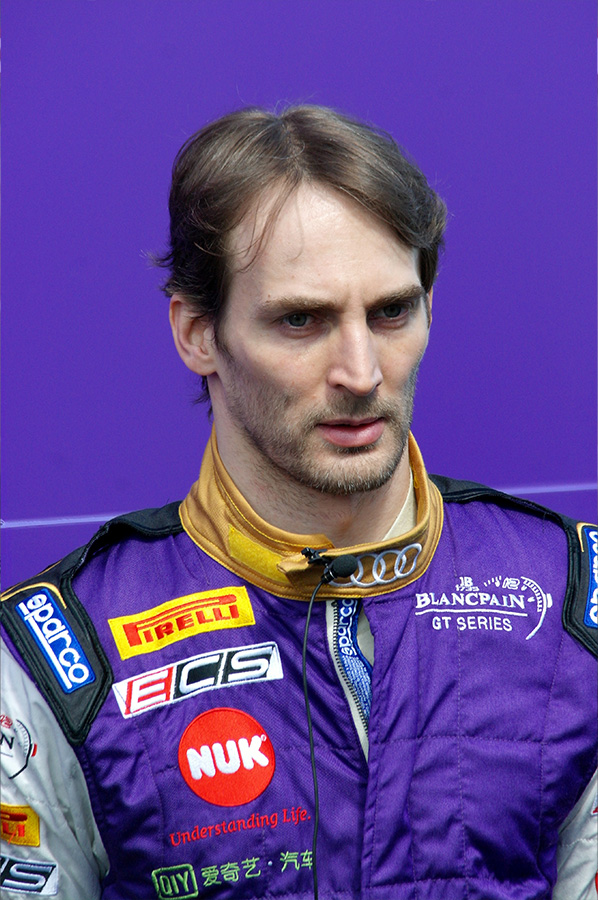
Macao racer and F3 champion, André Couto shares a different view from Marsh when it comes to holding an F1 race on the Cotai Strip, describing such an event as “a dream come true for any motorsports lover.”
“I think money is the only issue that [will] make it happen or not,” Couto says, adding that the city would also need to brace itself for significant infrastructural changes if a F1 race were to go ahead.
The driver also believes that having an additional track in Macao would definitely boost motorsports activity in the region. He notes that the Zhuhai International Circuit is currently the only one in the region where events are taking place on a weekly basis.
As for the proposed Hengqin-Macao crossboundary circuit, Marsh admits that it is “an interesting idea,” as it would be the first Grand Prix of its kind to cross between different
jurisdictions. At the same time, he points to the logistical issues involved in such a proposal.
McCartney also recognises the logistical challenges, drawing parallels with the crossboundary cycling competition that was successfully carried out between China, Macao and Hong Kong during the 2025 National Games. However, the academic believes that cooperation between government agencies would make it workable, with precedents in the events industry involving participants entering a particular jurisdiction visa-free.
Revamping the Macau Grand Prix
Rather than seeking to introduce a brand new F1 event or crossborder circuit, Marsh believes that Macao stands to benefit more from better leveraging the current Macau Grand Prix, which he notes is historically significant and beloved by many of the world’s top racers. A video posted by the FIA late last year highlights this clearly, with drivers such as Peter Dumbreck and Max Verstappen praising the Guia Circuit for its challenge and uniqueness.
Couto also holds the Guia Circuit in great esteem. When asked if it could be replaced by a potential Cotai F1 track, the racer says “it should not be replaced” because of its history and unique traits.
The racer makes it clear that the international reputation of motorsports in Macao rests with the track layout, which he notes is “so special.”
“I don’t think a Cotai Strip [circuit] can make that kind of special feeling that you have on the [Guia] track,” Couto says. “You have many types of corners. It’s a crazy track. Basically, you cannot reproduce that in a normal track.”
From Marsh’s point of view, the racing product of the Macau Grand Prix is already perfect as it is, with the China-Macau Motorsports Club doing “a brilliant job of running the race.” Rather, the racing analyst believes the event needs to attract more brands, VIPs and buzz in much the same way as it did when he first began attending the events in 1990.
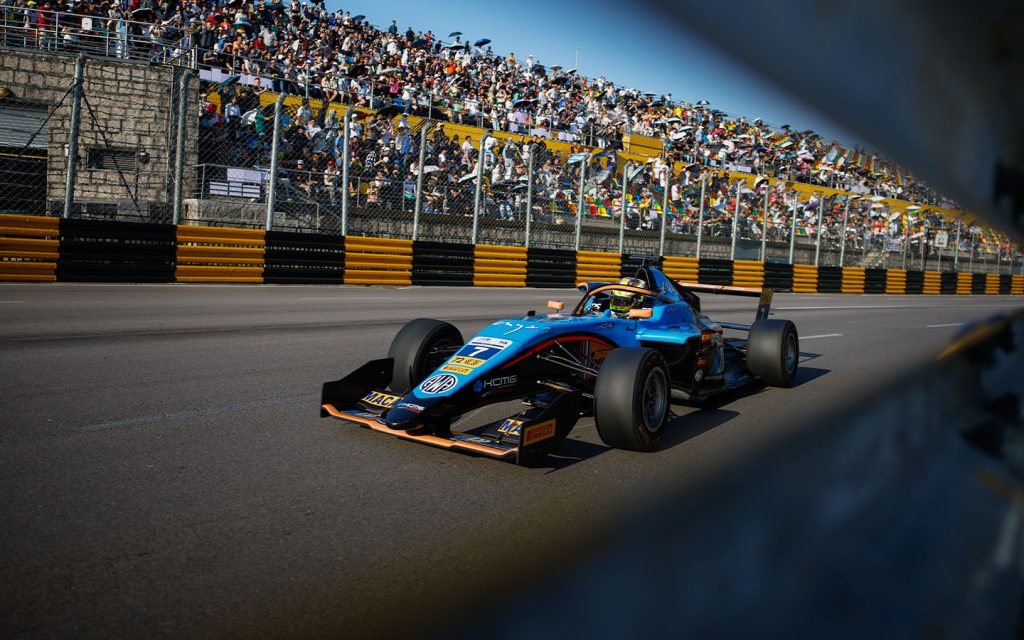
“In those days, it was a much bigger event because of the way the world was at the time,” Marsh recalls, adding that Hong Kong brands such as Cathay Pacific, along with Japanese firms, as well as cigarette and beer companies would generally sponsor cars.
“It was a mega event,” he says. “It still wasn’t promoted that well, but I thought it was loved by Macao and the people put effort into making it special every year. Whereas I look at it now and I think, there’s so much else going on that is not leveraged enough.”
Marsh believes that the organisers could heighten the festive feel of the championship by incorporating non-racing elements such as evening parties, VIP hospitality, music events and celebrity grid walks and pit lane walkabouts for fans on the quieter day.
Couto shares a similar view, pointing out that Macao could learn from other street circuit events held in Singapore and Miami, where entertainment events such as concerts are held in conjunction with their races.
[See more: Zero to Macao: Filming Vivian Siu’s 6-month journey to the Macau Grand Prix]
The underpromotion of the Macau Grand Prix is another area that Marsh believes needs to be addressed if the race is to turn into a mega event. Rather than seeing Grand Prix advertising as only promotion for the event per se, the motorsports expert says that the promoters should also treat it as publicity for the city as a whole.
He notes that advertising about the Macau Grand Prix on the Hong Kong MTR, F1 social media platform and other such channels would go a long way to remind people that “Macao exists an hour away by ferry.” At the same time, these Grand Prix promotional efforts would help people think of the SAR “in a cool way,” which would encourage them to visit the territory, even if they don’t necessarily attend the races.
While Marsh isn’t necessarily against the idea of F1 in Macao, he ultimately believes that the current Grand Prix would allow the SAR to gain 60 percent of the buzz from an F1 event at just 10 percent of the cost.
“In terms of what I think are realistic ambitions for Macao, or business issues or objectives to solve, the Macau Grand Prix already exists to solve them. It just needs to be leveraged better,” the expert maintains. “It’s already on the calendar. It’s already loved. It’s already got one of the best racing tracks on the planet.”