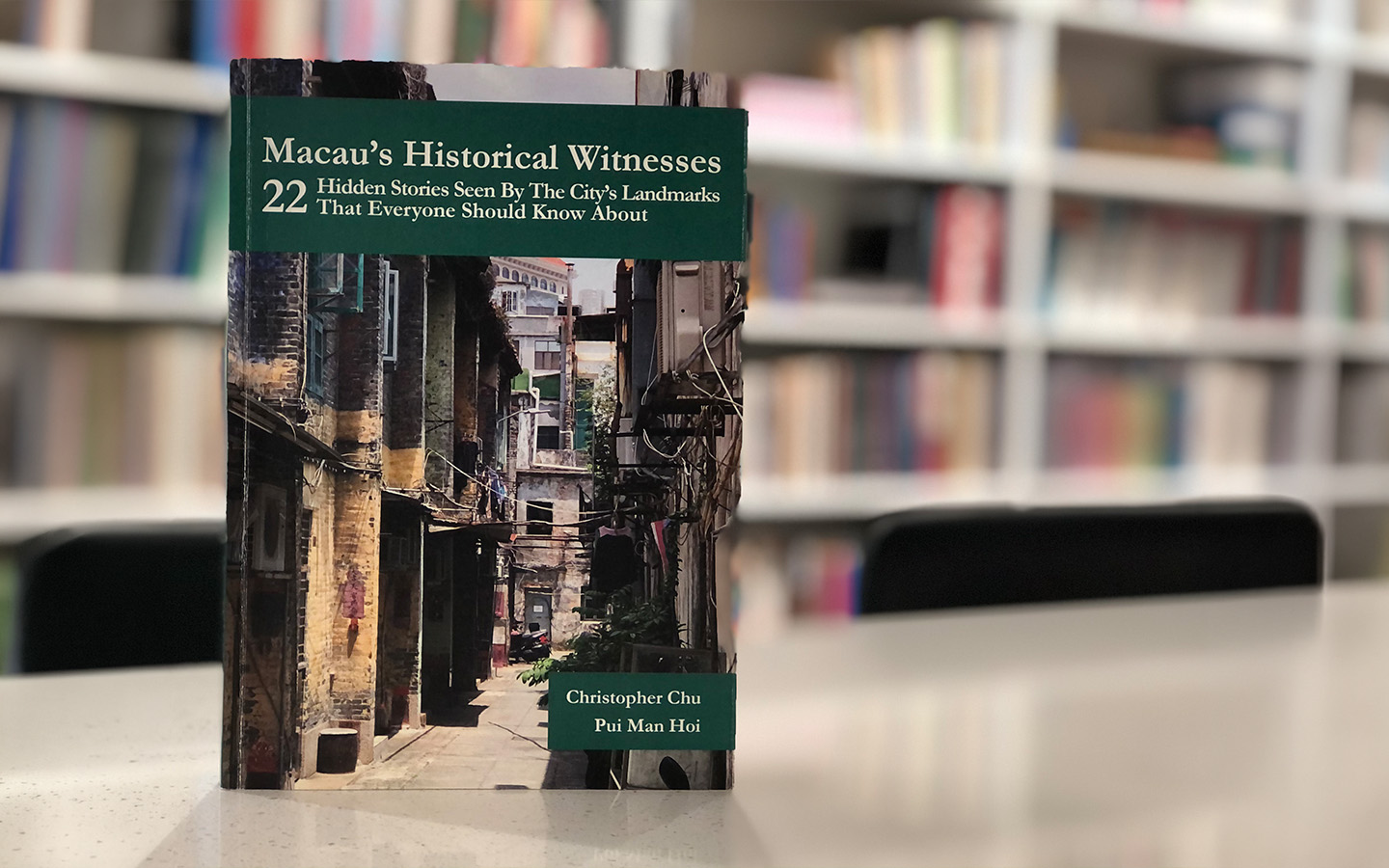
Commanding city buildings offer themselves as navigational signposts for visitors eager to understand and circumvent a new landscape. They centre us and help us to find our bearings. In Macao’s downtown area, seldom is it that we lose sight of the glittering Grand Lisboa, a landmark hotel whose towering design recalls a lotus flower in bloom (the lotus itself a symbol of Macao).
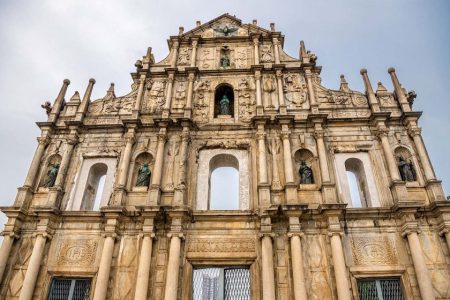
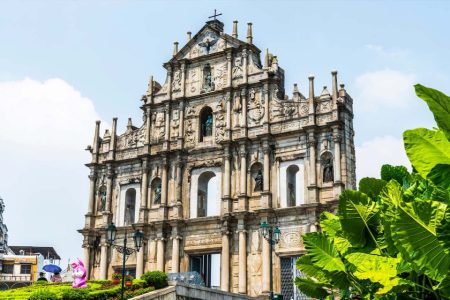
The hotel is a touristic attraction in its own right, as well as a gaming centre, and it boasts one of the world’s One Hundred most extensive wine cellars. It is a property which powerfully represents Macao, but perhaps only one version of Macao, such as that brought to life in last year’s frenetic Ballad of a Small Player, a movie directed by Edward Berger. But to view the Grand Lisboa, which opened in 2007, from the vantage point of Sé, the southeastern civil parish of the Macao Peninsula, is to see it as a mere backdrop to the centuries-old imposing baroque façade of the Ruins of St Paul. The church was built between 1602 and 1640, and the ornate façade, which is probably Macao’s most visited tourist attraction, depicts both western and eastern motifs.
It is this kind of juxtaposition which lies at the heart of the stories explored in Macau’s Historical Witnesses. Writers Christoper Chu (who works as an editor at The Bay) and Pui Man Hoi refer to the façade as Macao’s Acropolis, a “colossal compound” which serves as “a physical reminder of the prosperity achieved during the first one hundred years of the city’s establishment.” Major crises would soon follow, and the church itself would be all but destroyed by a kitchen fire in 1835.
Another historic church, St Antony’s, would also be damaged by fire, not once but twice (1809 and 1874), and both times it was repaired and rebuilt. We learn that the Chapel of Our Lady of Penha – which sits high on the hill above Bela Vista, a residence-turned-hotel, but now the home of the Portuguese Consul-General to Macao and Hong Kong – was financed by sea captain Jorge da Silva. This act of gratitude followed a deal he made with the heavens that, should he and his crew survive an attempted robbery by a Dutch ship in 1620, he would donate one percent of the value of the cargo to the church.
The Guia Lighthouse, meanwhile, would be the first Western-style lighthouse to be constructed in the Far East (1865); and Dom Pedro V Theatre (1858) the first Western-style theatre in China. Yet all of the Portuguese structures are significantly predated by A-Ma Temple, devoted to the patron goddess of seafarers, for the first Hall dates to 1488. Later, the complex would incorporate Buddhist, Confucianist and Taoist deities, as well as local folklore.
In the middle of cultural differences, then, buildings reveal how “Macao lives relatively harmoniously between Portuguese and Chinese ideas.”
[See more: 450 years of Macao’s Catholic Church: 5 stories you might not know]
Macau’s Historical Witnesses is also a story of those who built, sketched, worked in, worshipped in, and lived in and among these buildings, including influential writers, poets and artists. The tranquil and generously proportioned Camões Garden is named for Portuguese poet Luís de Camões, who is said by some to have composed part of Os Lusíadas in Macao. This text celebrates the life of Vasco da Gama, the fifteenth-century Portuguese explorer who, we are told, “may have been related to Camões’ grandmother”!
We learn that his writings were retold three centuries later, by Chinese reformist Zheng Guanying (1842-1923), in Shengshi Weiyang (Words of Warning in Times of Prosperity), which he wrote while residing at what is now called the Mandarin House. This sprawling complex was built before 1869 but, in 2001 “the government took over the compound, spending eight years renovating the complex until 2010.” Zheng’s work would in turn go on to influence the ideas of Sun Yat-sen, whose years spent in Macao included the founding of the Chong Sai Pharmacy in 1893 – which is included in the book as it remains in operation – and tourists can also visit The Sun Yat-sen Memorial Hall.
Then there is the serene Sir Robert Hotung Library, complete with tree-lined gardens, is the former residence of Sir Robert, a wealthy Eurasian businessman from Hong Kong, who fled to (neutral) Macao following the Japanese occupation of Hong Kong in 1941. Sir Robert was the grand uncle of gaming tycoon Stanley Ho, who would go on to become a hugely influential figure in twentieth-century Macao.
Amid fires, deaths and disease, pirates and the opium trade, the book reveals how Macao was also a centre of Christian thought, and a place of deep culture and learning, where Western and Eastern philosophies were embraced. Macao is easily evoked as a place where East meets West, even if that is a “lazy cliché.” But what can be discovered in historic as well as contemporary Macao, we read, is “what happens when different cultures collide.” Macao’s story is “a never ending one” incorporating “European and Asian characters and themes, evident in multilingual street names, fusion cuisines, and dynamic personalities”.
This book is enjoyable reading matter for the armchair historian but, given that it is a compact volume, it also serves as an illuminating walking companion. As the title asserts, many of Macao’s landmarks “stand witness” to the history which has moulded contemporary culture and society. Their juxtapositions reveal how, across centuries, the politics and economics of Brazil and Beijing, of Japan and Goa, have impacted this tiny territory. There is no history without geography, it is said. And there is no history without the telling, and the writing, of it.
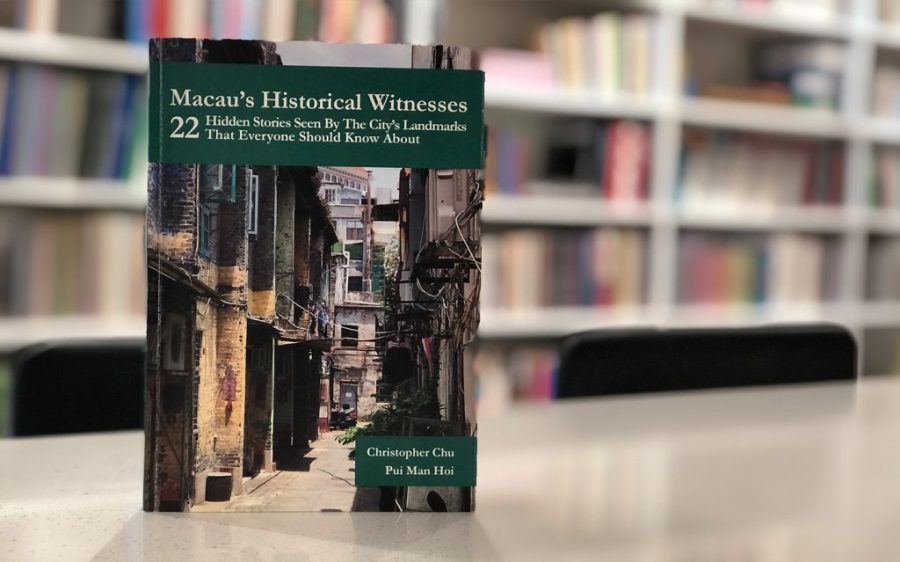
Macau’s Historical Witnesses: 22 Hidden Stories Seen by the City’s Landmarks that Everyone Should Know About, By Christoper Chu and Pui Man Hoi (2022), is available at Livraria Portuguesa and Loja Portuguesa.