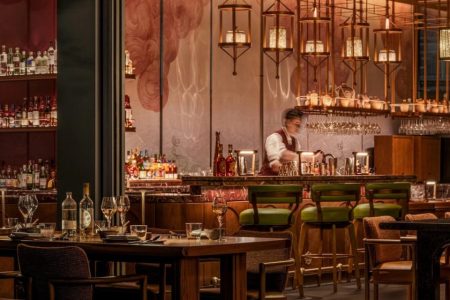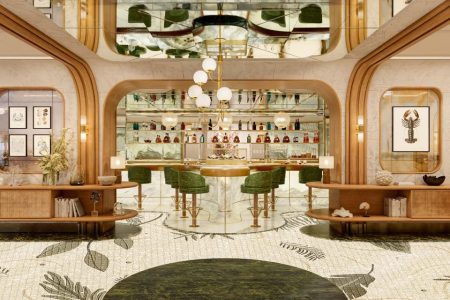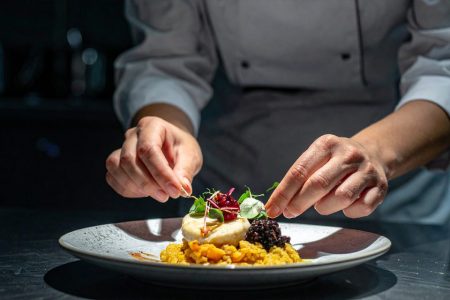
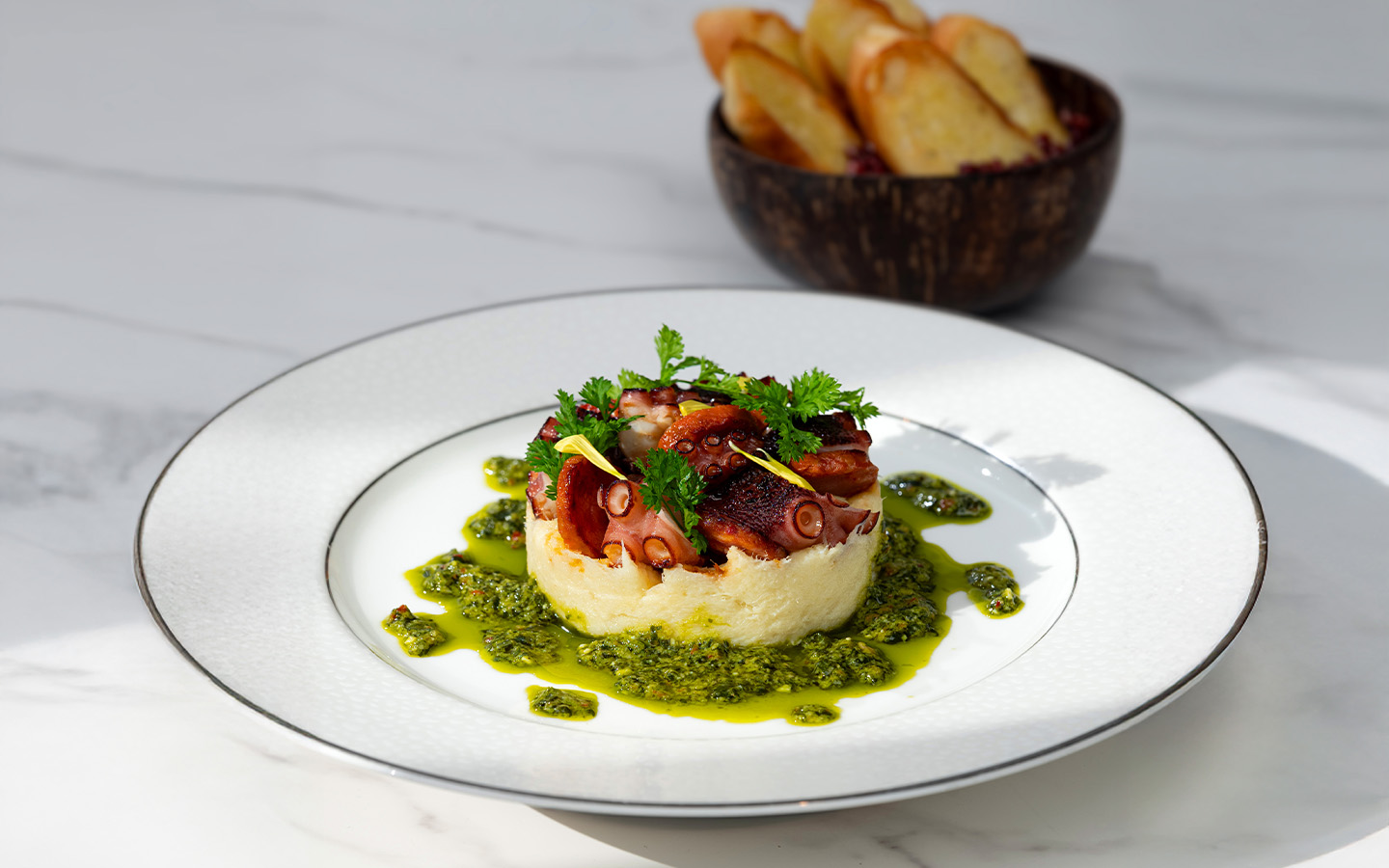
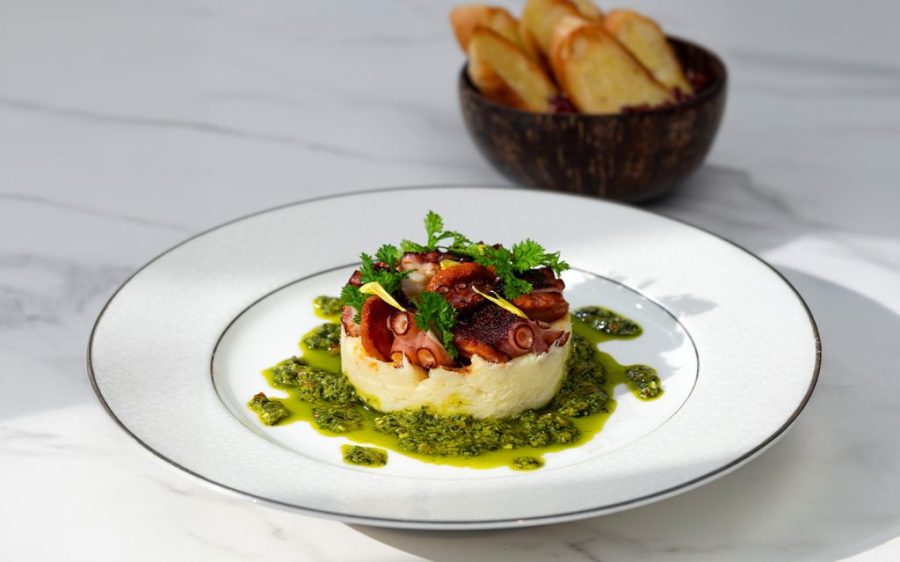
Bruschetta of Portuguese sardines in Azores butter; tartare of Japanese yellowtail with smoked caviar and dill; and grilled Australian octopus with brandade and nduja puttanesca, were among the dishes served at a Slow Food Macau lunch on 10 December at Vida Rica restaurant in the Mandarin Oriental, Macau.
The lunch was a celebration of Slow Food Terra Madre (‘Mother Earth’) Day – the day when the global agricultural and gastronomic network gathers to celebrate food which is good, clean
and fair, and to honour the people and places behind its production.
The five-course menu, designed by the hotel’s executive chef, Giulioantonio Di Sabato – a graduate of the University of Gastronomic Sciences, founded in Italy’s Piedmont region by Slow Food – centred on sustainability for the oceans.
The canned sardines, from Portuguese premium producer Jose Gourmet, are sustainable, while Portugal’s Azores – an archipelago of nine main islands – is famous for its pristine landscapes and agriculture, producing in particular high-quality dairy. The octopus, from Fremantle, Western Australia, is caught in specially designed cages that can only catch one mature mollusk at a time.
Both the octopus and the bacalhau (for the preparation of brandade) are certified by the Marine Stewardship Council – an international non-profit organisation that seeks to set standards for sustainable fishing.
Half-way through the lunch, to act as a palate cleanser and to aid digestion, local tea master Puilan Chan conducted a meditative tea ceremony. She reminded guests that even before taking in the aroma of the tea, one should take a deep breath to relax.
[See more: 10 questions for Chinese Cooking Demystified’s Stephanie and Chris]
She then prepared and poured Da Hong Pao (“Big Red Rope”), one of China’s most powerful Oolong teas, grown on the Wuyi Mountains in Fujian Province. It is one of the very few teas to have its own WTO Geographical Indication – equivalent to DOC in wine – as a guarantee of origin, traceability, and authenticity.
When the Slow Food Manifesto was signed, in a ceremony that took place in Paris in 1989, it was a vision well ahead of its time, but today many of its tenets are becoming mainstream. Given that Macao produces almost none of its own food, aspiring to Slow Food ideals is no easy task, but Chef Giulio reports that he serves almost 100 per cent sustainable fish and seafood today.
Chef Hans Rasmussen, who attended the lunch, runs the Educational Restaurant at UTM, the only restaurant in Macao to hold a Michelin green star. As he has said, there is so much he cannot do that he focuses on what he can do, such as reducing food waste through the implementation of the semi-buffet concept; and growing vegetables and herbs on classroom roofs.
Coincidentally, but fittingly, given that the Slow Food movement was founded in Italy, 10 December was also the day for the announcement that Italy’s national cuisine would become the first single style to be recognised by UNESCO as intangible cultural heritage.
In the bid for this classification, proponents had argued that the country’s “living gastronomic landscapes” reflect the impressive diversity of agricultural traditions, and that Italian cuisine steadfastly adheres to sustainability and seasonability, as well as no-waste cooking traditions.
The successful proposal also highlighted how the passing down of traditions within families, across generations, has created a deep connection to food, grounded in humanity and community.