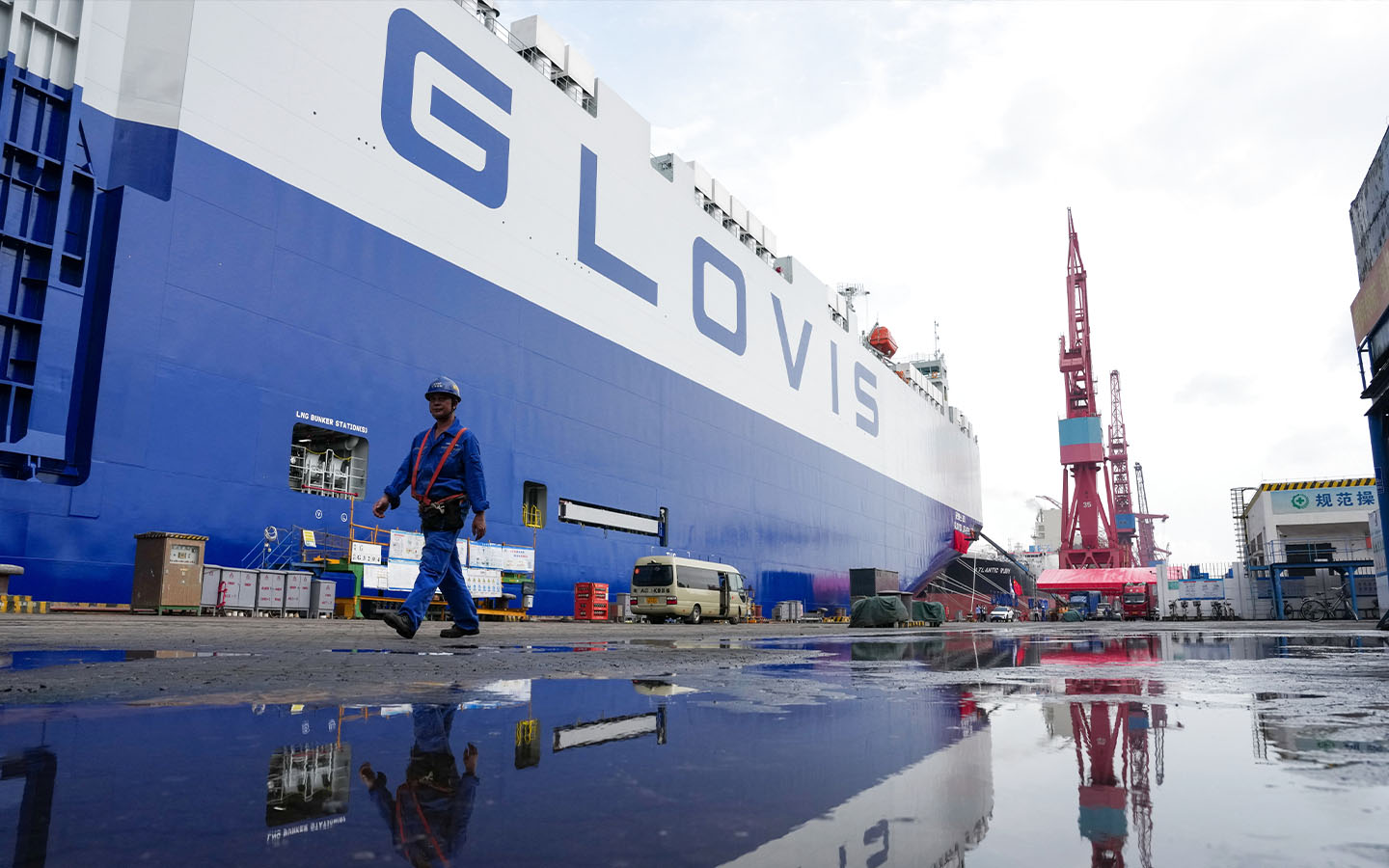
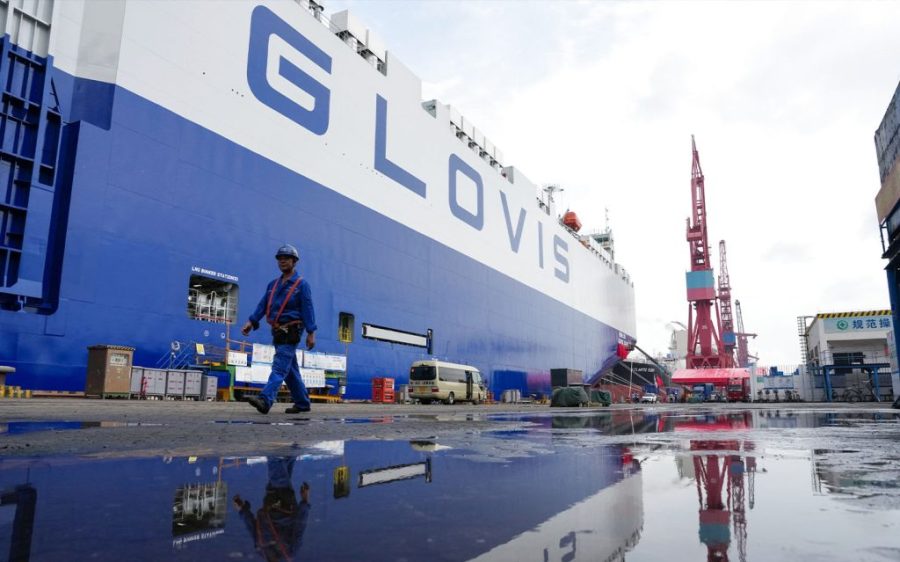
A car carrier made in China’s Greater Bay Area, and dubbed the largest of its kind in the world, was delivered in Guangzhou’s Nansha district on Tuesday, according to Chinese media reports.
With a length of 230 metres and a width of 40 metres, and room for 10,800 vehicles, the Glovis Leader was constructed by two firms – Guangzhou Shipyard International Company Limited, a subsidiary of the China Shipbuilding Corporation (CSSC), and China Shipbuilding Trading Co. Ltd.
The vessel was handed over to South Korean shipping giant HMM and is set to be operated by South Korean logistics firm Hyundai Glovis Co., Ltd.
In terms of specification, the Glovis Leader – capable of cruising at a speed of 19 knots – features a 10.5 metre design draft. The ship also contains 14 decks that are purely designed to house an array of vehicles such as electric cars, hydrogen vehicles and heavy trucks.
According to CCTV, if all the standard-sized 5 metre cars that the Glovis Leader can carry were formed into a straight line, their entire length would reach over 50 kilometres.
Meanwhile, the news outlet noted that if the car carrier were fully loaded with vehicles priced at a conservative 100,000 yuan, its entire cargo value would exceed 1 billion yuan.
The Glovis Leader also seeks to be eco-friendly by running on a dual-fuel system of liquefied natural gas and traditional fuel, which satisfies the Tier III emission standards under the International Maritime Organisation’s guidelines. Similarly, its hull design, heat recovery system, shore power capacity and other such technologies allow it to reduce energy consumption.
[See more: China maintains its position as the world’s leading shipbuilder]
“This ship is a green-energy vessel,” said Zhang Fuli, a technical manager with Guangzhou Shipyard International. “It can single-handedly use a shaft generator to produce electricity for the entire ship while at sea.”
Zhang added that if need be, the Glovis Leader could also be modified, so as to allow for power generation via ammonia or methanol fuel.
During the delivery ceremony, Hyundai Glovis CEO, Lee Kyoo-bok, was cited by Global Times as saying that the Glovis Leader was far from an ordinary form of transport, as the ship’s ultra-large capacity and sustainable systems represented a new standard for car-carrying marine vessels and a significant development in the shipping sector.
The Glovis Leader’s delivery in Guangzhou is not accidental, as the provincial capital has established itself as a key base for shipbuilding in China. According to Guangzhou Shipyard International, it had already delivered 26 out of the more than 40 orders it has received so far.
Interionationally, China remains the world’s largest shipbuilder, with government data showing that the country built 53.69 million deadweight tons of vessels in 2025 or 56.1 percent of the world’s shipbuilding output.
In 2024, China marked a new shipbuilding milestone when its first domestically-built large cruise ship, Adora Magic City, set sail on its first commercial journey from Shanghai. The country is set to deliver its second homegrown large cruise ship, Adora Flora City, on 6 November 2026.