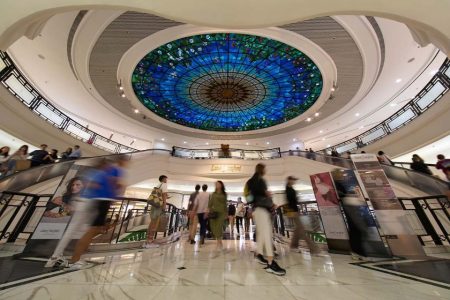
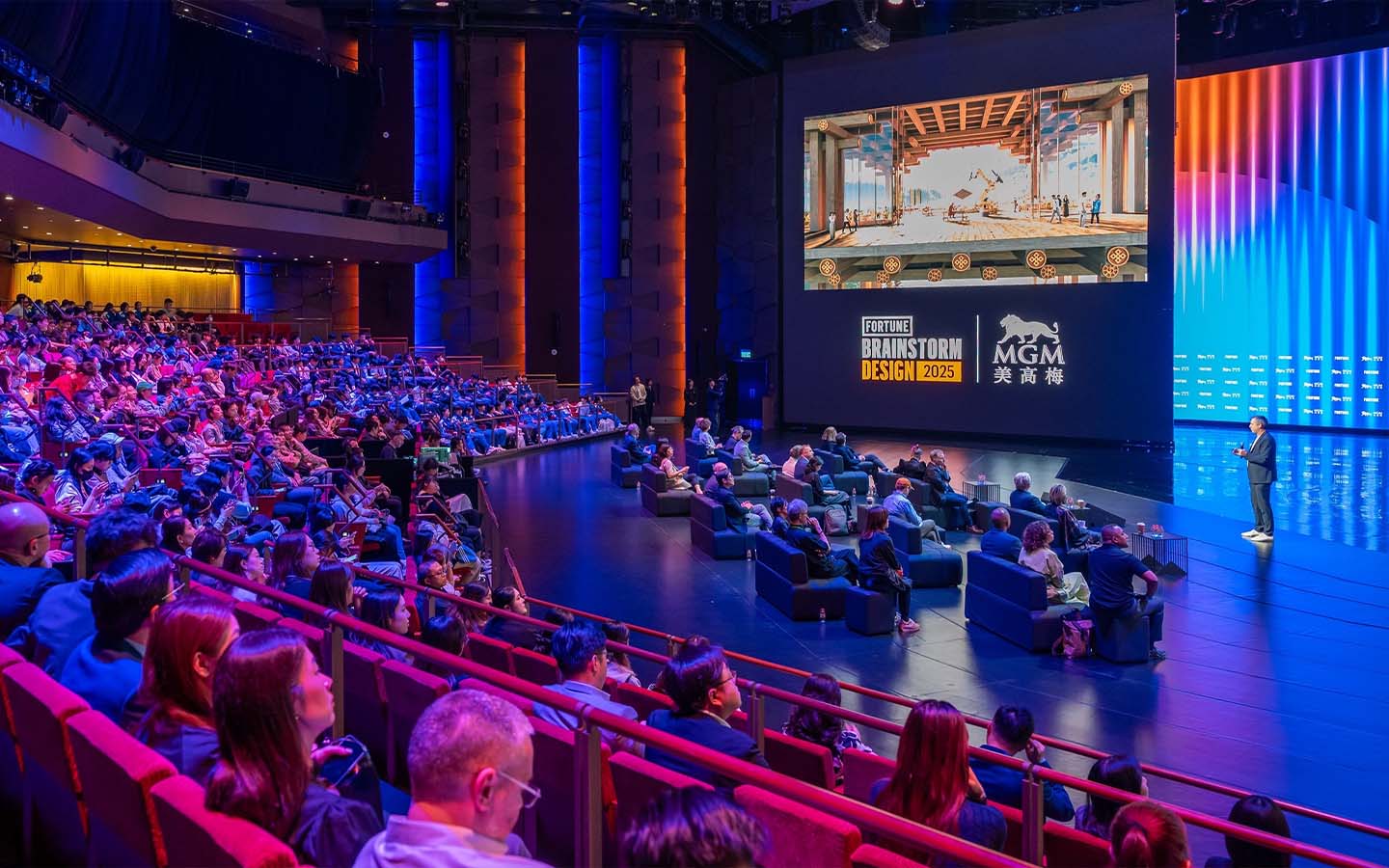
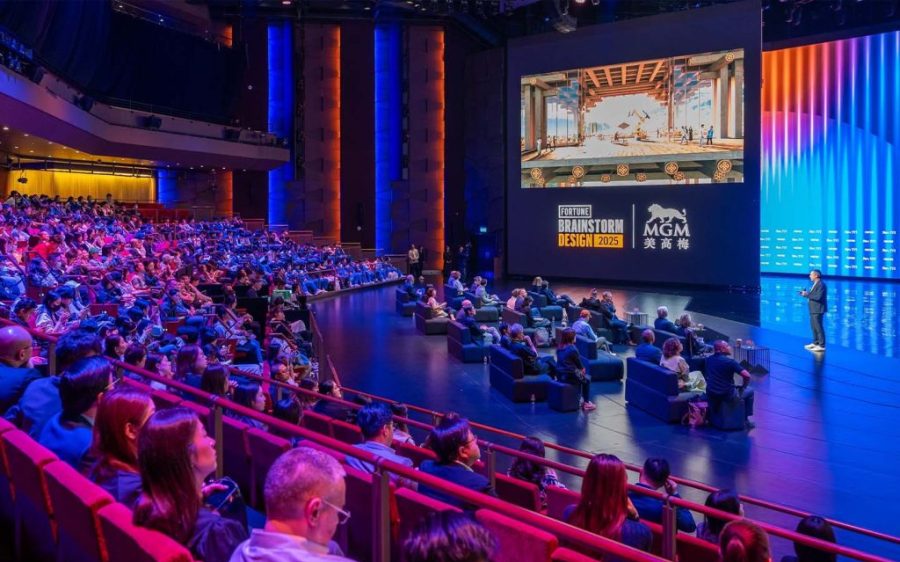
The Fortune Brainstorm Design conference – a gathering that seeks to facilitate conversations about design, business and technology – was held on Monday and Tuesday at MGM China’s properties in Macao, with hundreds of the world’s top designers, business leaders and experts attending. The event emphasises MGM’s “commitment to bringing premium international conference resources to Macao,” as well as to strengthen its role as a hub for global connectivity said Kenneth Feng, President and Executive Director of MGM.
Monday’s proceedings took place at MGM Cotai and were attended by various guests who delivered talks based on the theme of Cultural Preservation with Technology.
Heritage and technology
The keynote address was given by MGM’s senior vice president of brand marketing, Catarina Lio, who discussed her work as the executive producer of Macau 2049, a residency show staged at MGM Theatre.
Directed by renowned Chinese filmmaker Zhang Yimou, Macau 2049 showcases Chinese culture in an innovative manner by blending technology elements such as robotic arms and laser projection.
“When technology meets art, it creates a universal language that transcends generations and cultures, resonating especially with young audiences,” Lio pointed out.
[See more: Macao designer Leong Son U achieves historic win at World Stage Design 2025]
The MGM executive mentioned that this was especially important because new methods were needed when it came to cultural preservation.
Taking into account the younger target audience and their short attention span, MGM ultimately settled on an 80-minute, 8-chapter show “without one single storyline,” which can be understood visually.
“We believe that global participation and a global language with the traditional heritage can create a new future,” said Lio.
Computers and craftsmen
After the keynote address, a number of speakers took to the stage to share their projects and insight regarding the merging of tradition with technology. They included Martin Voelkle, a partner at Bjarke Ingels Group (BIG); Andrew Lazarow, the studio leader at LAB @Rockwell Group; Ismael Merchan, an architect at Populous, and Monika Bielskyte, a Futurist in Residence at Nike and founder of Protopia Futures
Voelkle’s presentation focused on his Danish architectural firm’s design of the Gelephu International Airport in Bhutan, which will have a unique timber structure that features traditional Bhutanese carvings.
Although BIG hired local craftsmen, the company also made use of computational specialists and a robot to overcome the impracticality of making wood carvings by hand for a venue as large as an airport.
[See more: Shenzhen Design Week kicks off with awards, a designers’ congress and more]
“The robot is replicating what the traditional carpenter is doing,” Voelkle said. “Of course, the robot doesn’t yet have enough skill and recognition of the wood, so basically we’re working with a drill. But the next step would probably be [to have] the robot actually using the knife to carve the wood.”
Meanwhile, Bielskyte highlighted the potential of merging science and technology together “to make us feel more connected to our bodies, to our sensory capacity.” The futurist mentioned that this would not only allow humans to surpass their physical capabilities, but would also enable us to “experience more joy of inhabiting this complex biological realm that we are in.”
Adoption of new technologies
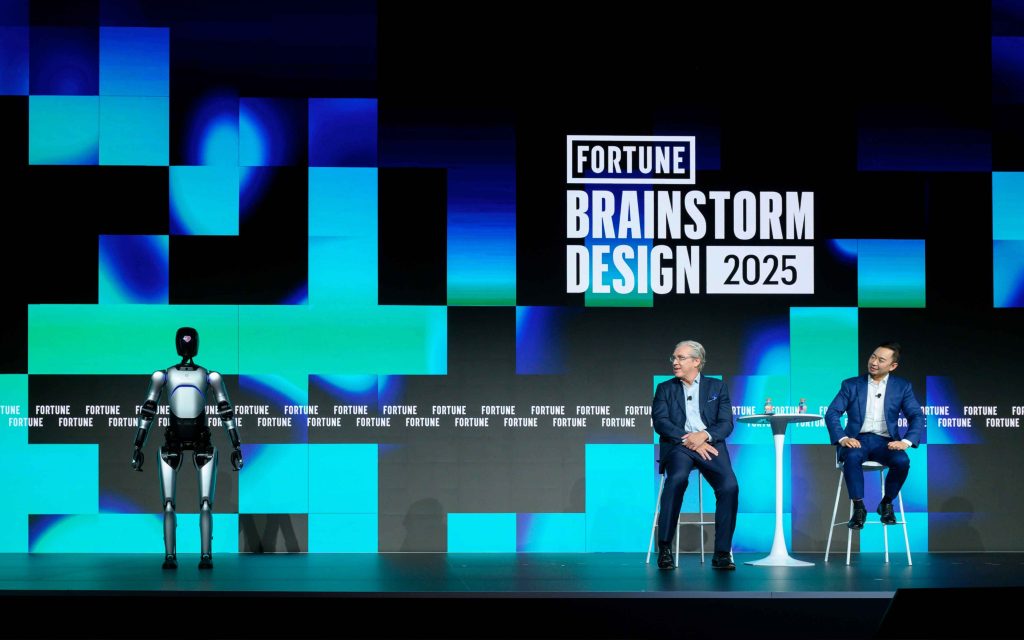
On Tuesday, the Brainstorm Design forum continued at MGM Macau, with the event’s co-chair and the executive editor of Asia Fortune, Clay Chandler delivering the welcoming remarks.
“This year’s theme is future tense, prototyping tomorrow,” said Chandler. “Rapid acceleration of AI and other digital technologies promise breakthroughs in productivity, but they are also disrupting the fundamental nature of work. They threaten to wipe out millions of jobs and may be setting some stage for a huge speculative investment bubble.”
A number of talks followed, including one about the use of AI in design and branding, which featured Mauro Porcini, the president and chief design officer of Samsung.
Porcini began with a discussion of his experience as the first chief design officer of PepsiCo – a role that he undertook for 13 years before assuming his new position at Samsung six months ago.
[See more: UM to enhance Macao’s design industry with new postgrad programmes]
He noted that the biggest competitive advantage that one can build for one’s company is to “focus on people” and “creating something valuable for people.”
On the potential threat of AI and robots, the Samsung representative said that the new generation wanted companies to direct these technologies in a positive direction, with Samsung looking to design its products based on four categories that seek to put the focus on people – living longer, living better, living louder and living on.
In terms of the aesthetics of technology and the current preference for minimalism, Porcini said that “we deserve the possibility of choosing different kinds of languages.” He mentioned that “my idea is to move technology towards the world of an expressive design language,” adding that “there is space for more poetry.”
Form follows function
Another talk, involving Ole Scheeran, the principal of architectural firm Büro Ole Scheeren, was also held, with the architect delving into the architectural principle of “form follows function,” which calls for structure to be designed in a way that fits with their designated purpose.
“Architecture needs to go beyond plan, programme and diagram,” the architect argued. “It should be understood as a dynamic system of configuration, complexity and narrative in our work. We think of buildings as living organisms.”
Scheeran gave examples such as the Mahanakhon Tower in Bangkok, whose design reflects the surrounding urban landscape and made use of a storyboard that delved into the experiences and emotions of the people who visit the space.
Currently, Scheeren’s firm is working on a number of projects in China and around the world, including Tencent Helix, the Chinese tech firm’s headquarters in Shenzhen. He highlighted the building’s central “vortex garden,” a large space that integrates the exterior and interior together.
[See more: How this Macao designer helps brands tell their stories in eye-catching new ways]
“It’s really this idea of this human ecology inside the building, where focused work comes together with a myriad of other possibilities and where we give people the choice to retreat, to congregate, to exchange and collaborate,” he said.
Speaking about his design style, Scheeran highlighted the strong links between cinema and architecture. He said that much like films, architecture also has the potential to take people on a journey and experience.
“I believe architecture really shouldn’t be prescriptive, but it shouldn’t be anything generic” the architect said. “It has to trigger emotions.”
On the question of how technology was impacting his work, Scheeran said that the industry was attempting to strike “a productive balance between engaging in these tools and engaging in the new possibilities,” and the human qualities and instincts that should be retained in architecture.
Design and personalisation
Meanwhile, André Fu, the interior architect and founder of André Fu Studio and Toby Smith, the deputy chairman of Swire Hotels, explored their Upper House brand of luxury hotels, which embraces the hospitality concept of creating “houses not hotels,” or personalised and authentic service for guests.
Fu noted that when he started his career, hotels were largely major brands that were attempting to replicate the same cookie-cutter style, equating luxury with grandeur. However, he stressed that luxury is not simply about the “fabric” or “marble,” but rather the “feeling”, “connection” and “emotion.”
“You put the guest as the priority, and you really think of how he walks into the space, how the door opens, what he sees, and when you have that feeling this is a space designed around you, rather than you being just a part of that environment,” Fu said of his own design principles.
[See more: The newly revamped Hotel Central has won a design accolade]
Meanwhile, Smith added that the Upper House properties are designed so that “the guest feels immediately at ease,” with interfaces that are intuitive. Service-wise, the brand also seeks to set itself apart from other labels. As an example, Smith mentioned that guest experience team members at Upper House Shanghai are willing to take 10 minutes out of their time to walk with a guest wishing to visit the French concession.
Moving forward, Smith and Fu mentioned focusing on future Upper House projects, including properties in Shenzhen and Tokyo’s Shibuya district.
This year’s Brainstorm Design forum marks the third consecutive year that Macao has hosted the event. First staged in Singapore in 2018, Brainstorm Design has established itself as one of the leading business and design conferences in the world, attracting leading experts and professionals from a range of sectors, including product design, architecture, transport, travel and hospitality.