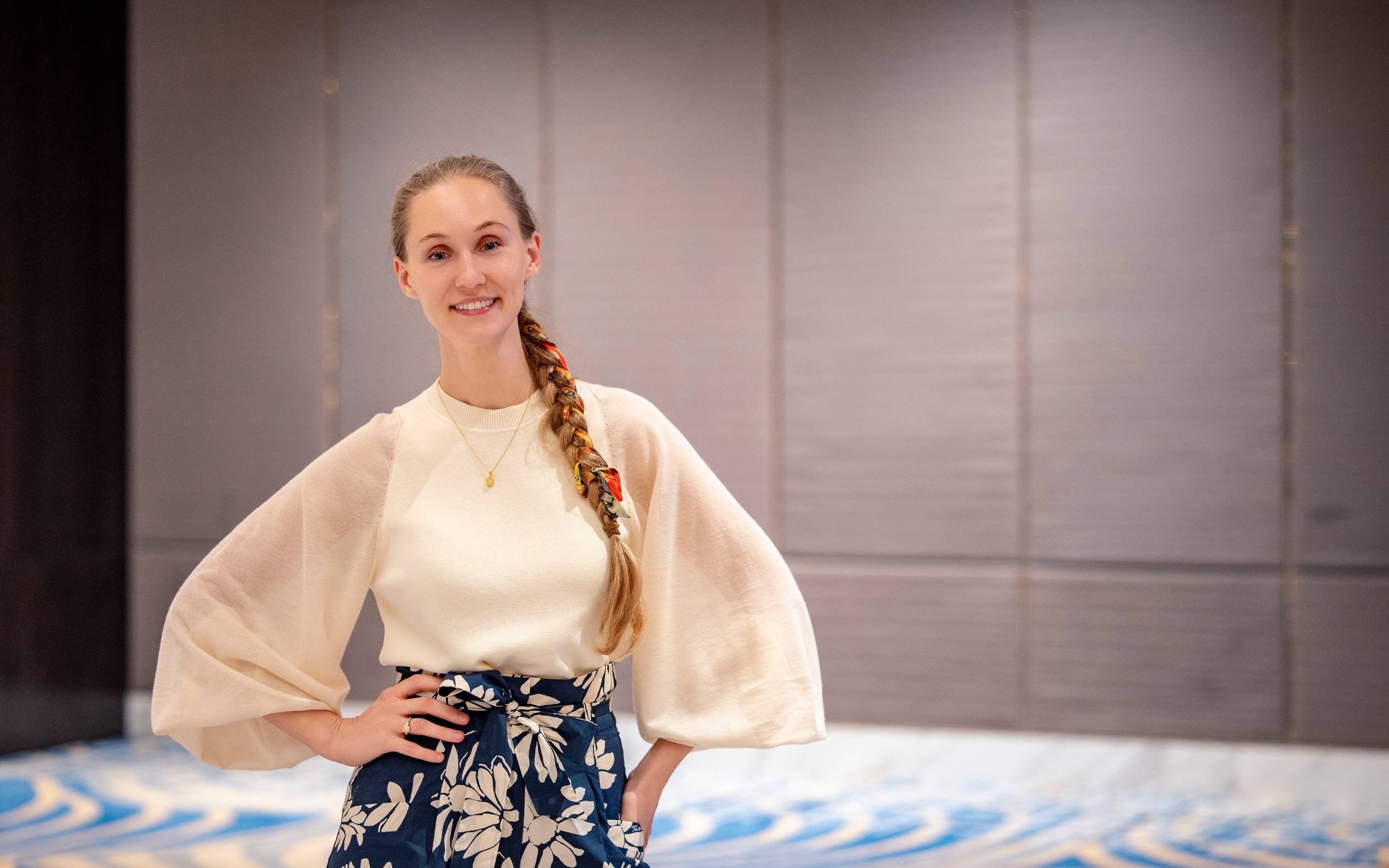

Ashley Dudarenok is a person of many talents. At just 37 years of age, the Russian-born Dudarenok has a multitude of titles to her name, including China watcher, thought leader, keynote speaker, and author. However, she considers herself to be first and foremost an entrepreneur.
“Entrepreneurship is a way of life. It’s how you approach everything,” says Dudarenok.
The naturalised Hongkonger’s business acumen is well-demonstrated by her two China-focused companies, ChoZan and Alarice. The latter – established in 2011– is a digital marketing agency that helps overseas companies such as Crocs and Jack Daniel’s build a social media presence in China.
Meanwhile, Dudarenok’s China research and digital transformation firm ChoZan was founded in 2016 with the aim of educating foreign firms about China’s approach to innovation, disruption and business transformation via services such as innovation research and learning expeditions.
Ashley’s success as an entrepreneur in China is especially inspiring given her beginnings in Vladivostok in the final years of the Soviet Union — a place and time where business opportunities and mindset were limited.
[See more: Guangdong sets out plan to drive Greater Bay Area integration]
That all changed at age 17, when she moved to Chongqing to study Chinese. Immersing herself in China’s Southwest became a turning point — a journey that led to language fluency, deep cultural understanding, and ultimately her path as an entrepreneur.
With a keen eye for business, it was only a matter of time before Dudarenok found herself drawn to Hong Kong, which she notes is a “good place for entrepreneurs because it provides you with plenty of opportunities to add value, be resourceful and make money.”
As Hong Kong continues its integration into the Greater Bay Area (GBA), the city’s business opportunities are only set to grow across a range of sectors such as technology, innovation finance and healthcare.
We spoke to Dudarenok to get a rundown on the GBA, including the advantages and challenges of doing business in the region and her thoughts about its development.
This interview has been edited for brevity and clarity
In your opinion, how well known is the GBA internationally?
It’s really a tale of two audiences because among finance and tech professionals, the GBA is increasingly well-known. For example, when you talk about Silicon Valley or Tokyo Bay, those people that know those two things in one sentence would typically know what the GBA is. After all, the GBA has already surpassed Tokyo Bay by a big amount.
[See more: Great Bay University inaugurated in Dongguan to support GBA talent pipeline]
But when it comes to the general international public, it still remains a very much misunderstood concept. Many people think that with the Greater Bay Area, you’re still talking about the US. Many people also do not know what’s actually included in the GBA. They only think it’s Hong Kong, Shenzhen and Guangzhou. They do not really understand that there are other cities, including Macao, Zhuhai and many others.
What do you think can be done to promote the GBA to a wider audience?
Whenever I look at GBA reports, it’s all economic statistics, the number of people, the number of output and all that. But we need to move to tell more compelling human stories instead of just manufacturing powerhouses and potential for integration within the region.
We need to talk about creativity. We need to be talking about lifestyle and real entrepreneurs. We could collectively host some very high profile international events. We could leverage more digital platforms to create engaging content, sharing day-to-day kinds of stuff.
[See more: There’s a new official guide to living and working in Zhuhai]
Fostering cultural exchange – we definitely need to do that. Maybe create some GBA sports games, entrepreneurship fund or innovation centre that actually brings global community in those sectors to us. There’s just so much to do on both the marketing side, as well as policy and support side.
Why should someone do business in the GBA?
First of all, it’s a massive consumer market. There is a world-class innovation ecosystem. There’s also a bit of access to global capital, especially for mainland Chinese companies.
Looking at where we are numbers-wise, it is very impressive. Our population is around 86 million people and when it comes to innovation hubs, we are at 75,000 high-tech enterprises.
Of course, global giants like Tencent and Huawei, they’re also based here.
[See more: Here’s a guide to the ‘other’ Greater Bay Area cities]
But it’s also a financial gateway. For someone from mainland China, access to going global and global markets through the Hong Kong financial hub is important. Also our access to Pearl River Delta manufacturing facilities and the whole Guangzhou supply chain is also extremely powerful.
I think we have a lot of policy support and government involvement on all sides. The authorities are all very willing to support. They want it to be the launch pad for the future.
What are some of the challenges that overseas firms face when trying to enter the GBA market?
The first significant hurdle is how to navigate the complex regulatory landscape. It’s very opaque in many ways. If you want to enter here to use it as a market and to sell in the GBA, you also face local players, various cultural barriers and so on.
But if you just want to be set up here, it’s also complex to understand – shall I be in Shenzhen or shall I move to a certain special part of Shenzhen that has an industrial zone or shall I be in this other part of Zhuhai? It’s really like this.
[See more: The GBA is only in third place nationally when it comes to hosting ‘pre-unicorns’]
The speed of the market is another problem because everything changes fast. If you’re not located here, or if you’re not integrated into certain industrial parks, or you’re not in touch with people that make policy or are leading your industry discussions in this region, you might, very quickly, within a few months be out of the loop. That is just the way this region operates.
The final one is the region is not so well known. Whenever you’re trying to sell to your own company or business, there’s a lot of education that you need to do before you get final approvals.
What are some of the main opportunities for firms looking to get into the GBA?
There’s a wide range of sectors. Firstly, of course, fintech. Hong Kong, of course, has deep financial expertise. Shenzhen has tech powers. There’s a lot of opportunities in the fintech space from wealth management schemes to new ways of listing firms to new ways of accessing capital.
The other one is healthcare. The ageing population in mainland China, around the world, in our region here, and the demand for high-quality healthcare and new treatments make it a very sexy industry, not only in the GBA, but globally.
In Hong Kong and Macao, we have “Medicine and Equipment Connect,” a policy that makes it easier for international healthcare companies to enter the market. In Hong Kong, there are also very strong research facilities and universities that are pushing out innovations. In mainland China, we can test them. We can get approvals easier, and then ultimately we can launch it on the market, and later on scale it around the globe.
[See more: The Greater Bay Area’s first international business talent centre opens in Shenzhen]
Another one is green tech. GBA’s commitment to sustainable development creates huge opportunities in electric vehicles, renewable energy and green finance. In Guangzhou and Foshan, the hydrogen energy industrial base is one important example. For example, you go to Shenzhen and all the public transport is green, and we are starting to see more and more EVs in Hong Kong.
The final one is e-commerce and retail. We have a massive consumer market. There’s a lot of opportunity to manufacture small batches fast and then unleash them onto local and global audiences.
Is there a big language barrier for foreign firms entering the GBA market?
In places in Macao and Hong Kong, no. In Guangzhou, we also have a lot of English-speaking professionals who are well-versed in international trade. Places like Shenzhen and Foshan are also very much focused on international trade.
For me, I don’t see it as a huge stumbling point. If you expect it to be native English all the time throughout the whole GBA, that won’t be the case. But we have very friendly people, and a lot of highly qualified professionals.
[See more: Foreign investors are flocking to Guangdong]
The inconveniences, in my view, are minimal, and if nothing else, they are exciting because you get to see a different world, a different culture and a different way of doing things.
Can you highlight some of the policies that have helped you to establish your office in Shenzhen?
When you set up a company in Shenzhen, first of all, you go to a specific district in an industrial zone and you can register your firm there almost for free, and then you can apply for free office space.
We were considering getting that done because you can have a free company set up and you can for the first one, two or three years, depending on your business category, have a free commercial space. We did not do it. Why? Because we wanted to be very, very close to Hong Kong – Shenzhen border crossing.
[See more: Hong Kong retains GBA lead in finance, trade and tourism as AI reshapes regional industries]
Literally, the moment you walk out of the train, our office is just opposite. It’s like a 5 minute walk, whereas I know a lot of companies who do not mind a 20 minute taxi ride from the border that took the policy and used it.
Depending on the business that you’re in, you can also apply for various grants. There’s double taxation relief with Hong Kong initiatives, depending on your company’s scale and your specific situation. We have, over the years, used multiple support initiatives to help our business.
What’s one piece of advice you would give to a firm looking to get into the GBA?
Find a local partner. It is ultimately a complex and nuanced market that has a lot of opportunities, but you need a local partner to help you navigate what’s going on – not just in the regulatory landscape, but also in understanding the local business culture and connecting you with the right people. It’ll also save you a lot of time in research, verification and whatnot.
[See more: GBA business confidence hits a four-year high in the third quarter]
A good local partner is important and very often you can get a partner by hiring them in the business or giving them a share of the business, or just hiring them as a consultant first and later on looping them in the business.
What’s one common misunderstanding that firms have regarding the GBA?
Don’t assume just because it’s the GBA that what works in Hong Kong will work in the mainland or what works in Macao would work in Foshan and vice versa. It’s one district, but it has its own peculiarities. Each city has its own strengths and weaknesses, and it’s not a one size fits all, but every city in the GBA region is incentivized to support your growth.
[See more: The GBA has natural advantages when it comes to the space race, FMCC speaker says]
If you are committed to finding a way to maximise your opportunities in this region, it will come together as a puzzle piece. You just need to put this puzzle together for your specific situation. Your Foshan operations, for example, can reinforce what you’re doing in Hong Kong and you can make sure that it actually empowers and makes your business thrive better and faster.
Where do you see the GBA going in the next decade?
I think it will solidify its position as one of the world’s most important economic and innovation hubs. I’ve been hearing about and living in the GBA for years and it’s only over the past five years I started feeling that we are becoming that one region and there are meaningful projects that are actually moving the needle.
In the next decade, I hope that this process will be accelerated and it will finally amount to real change.
[See more: Guangdong claims 54 spots in China’s top 500 companies]
We will have the physical and digital infrastructure, which will be more seamlessly integrated and it will ultimately create a unified market. Hopefully, the one hour living circle will be a reality for millions of people, who will be able to live, work and play across the region much more easily.
This interview was produced in partnership with the Entrepreneurs Organization’s Greater Bay Area Metropolitan chapter.