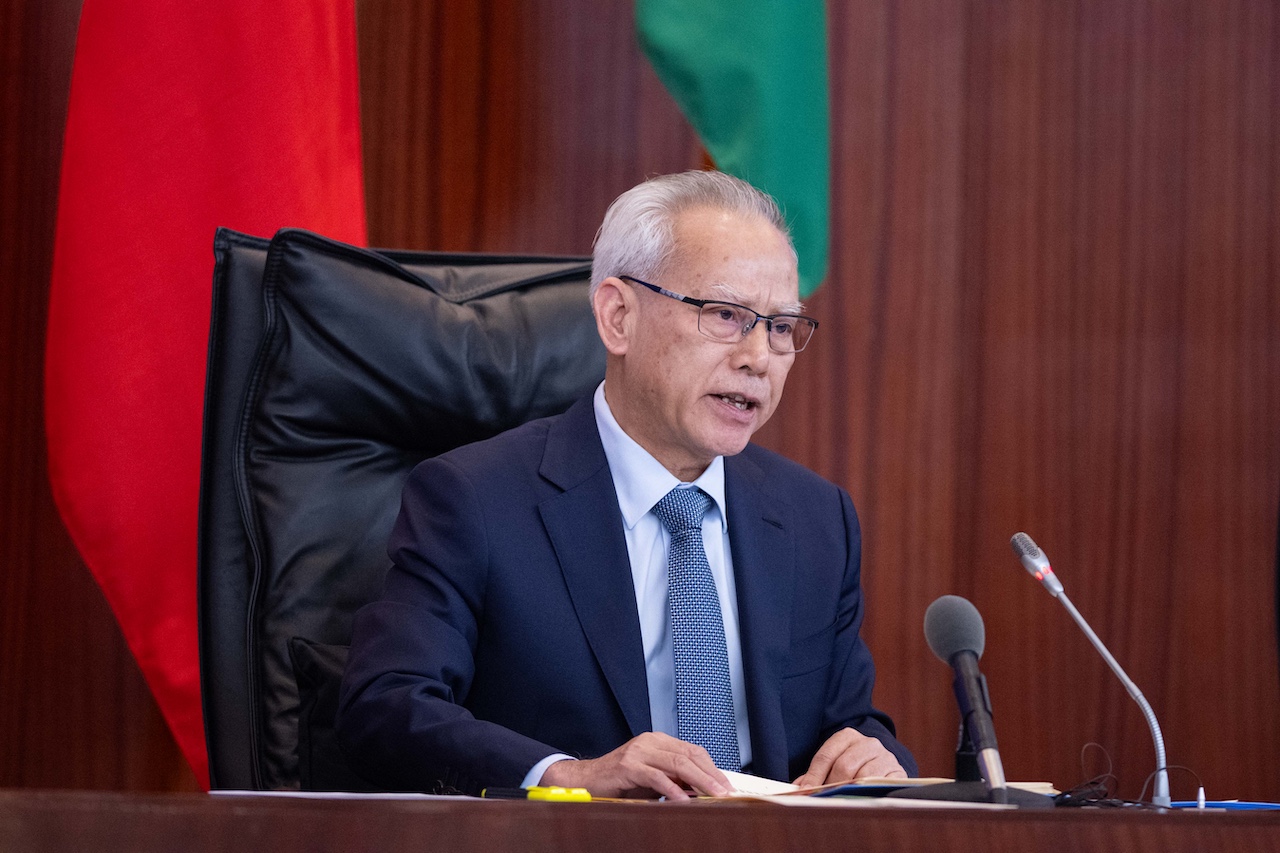
Chief Executive Sam Hou Fai delivered his 2026 policy address on Tuesday, setting out welfare measures, administrative reform and Greater Bay Area (GBA) integration as key priorities.
Sam confirmed permanent residents will again receive 10,000 patacas and non-permanent residents 6,000 patacas next year via Macao’s Wealth Partaking Scheme, with the existing 183-day residency requirement unchanged. “The ultimate goal of governance is to ensure that residents can live a better life,” he said.
Several allowances will rise next year, including marriage allowance (to 4,000 patacas), unemployment allowance (to 210 patacas per day) and funeral allowance (to 5,200 patacas). The caregiver allowance increases to 2,400 patacas monthly, whilst families receiving financial assistance will get an additional month’s aid.
[See more: Hengqin Cooperation Zone leadership reshuffled as Cheong joins legislature]
Macao’s low fertility rates, meanwhile, will be actively addressed through a range of measures. For the elderly, the government plans to work with the relevant authorities in Zhuhai and Zhongshan to facilitate referrals to elder-care homes in Guangdong Province. Youth policies will include raising mainland internship places for university students to 620 and continuing GBA financing support schemes.
Sam described the city’s deeper GBA integration as an “irreversible trend”, highlighting more than 23,000 residents now living and working in Hengqin. The government will expand medical insurance subsidies to cover all of Guangdong and Fujian provinces.
[See more: The plans for Macao’s new integrated tourism and cultural zone have been unveiled]
Further initiatives to enhance healthcare standards in Macao and optimise the city’s housing policies were also announced. The chief executive outlined several major infrastructure priorities, including advancing the Macao-Hengqin International University Town, the Macau International Zone for Integrated Tourism and Culture and an upstream cargo terminal for the airport in Hengqin.
Economic diversification remained central. Sam pointed to GDP’s rebound from first quarter’s -1.3 per cent contraction to 8 per cent year-on-year growth in the third quarter, noting the city achieved 4.2 per cent growth overall with nearly 30 million visitor arrivals.
Administrative reforms include reorganising the Economic and Technological Development Bureau, merging the Consumer Council with the Science and Technology Development Fund, and consolidating the Cultural Affairs Bureau, Cultural Development Fund and Sports Bureau.
[See more: Opinion: Why digital assets could be key to Macao’s economic diversification strategy]
Sam announced plans to improve public transport – including studying online ride-hailing feasibility – and advance the Light Rapid Transit East Line, now 40 per cent complete. He also said he hoped to visit Portugal during the first half of next year as his first overseas trip as chief executive.
Another 2026 priority will be national security legislation, including work on anti-terrorism and anti-money laundering.