

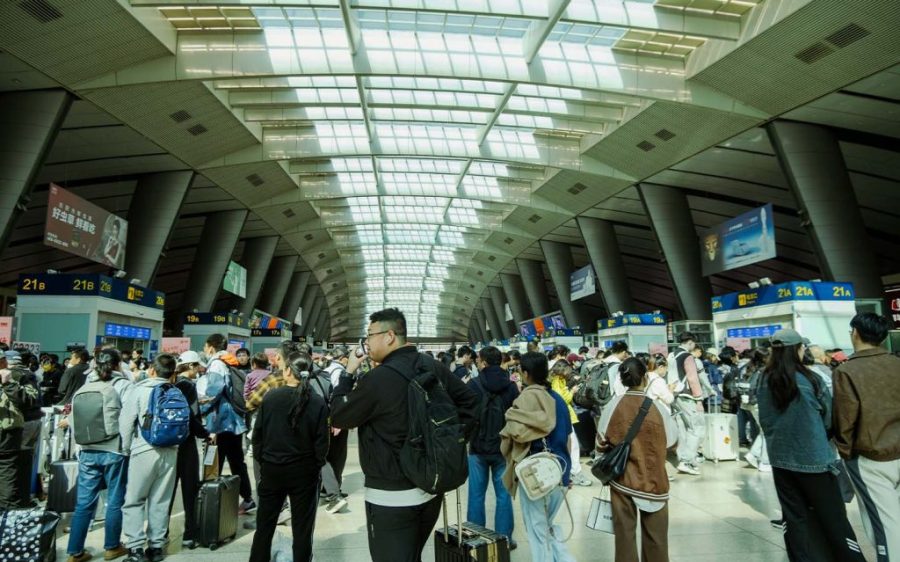
Guangdong’s train operator – China Railway Guangzhou Group – transported an estimated 1.31 million passengers across the province on the first day of the 40-day Lunar New Year travel rush yesterday. Year-on-year, this figure represents an increase of 24.76 percent (264,000 passengers), according to official data cited by Chinese-language media.
Overall, the railway service provider, whose tracks also span Hunan and Hainan provinces, carried around 1.89 million travellers yesterday, an increase of 18.4 percent (294,000 passengers) year-on-year.
With the travel rush period set to run until 13 March, China Railway Guangzhou Group is projected to handle a record-breaking 78.55 million passengers over this period, a rise of 4.8 percent (3.58 million passengers) year-on-year.
A considerable number of the train journeys will involve passage through Guangzhou South railway station. The transport hub is forecast to ferry approximately 21.35 million travellers during the travel rush period, a figure that is equivalent to around 534,000 trips per day – up by 3.26 percent year-on-year.
The number of passengers departing from Guangzhou South railway station during the travel rush is estimated to hit 11.15 million, with the peak departure period expected to fall between 12 and 15 February. Meanwhile, an estimated 427,000 passengers are scheduled to depart the station on 13 February, making it the peak day for departures.
To cope with the significant movement of people, China Railway Guangzhou Group has boosted the operating capacity of its railway network. A total of 4,459 passenger trains are operating on the network prior to the start of the Lunar New Year, an increase of 405 trains year-on-year. Similarly, the fleet will expand to 4,499 after the start of the festive period, a rise of 403 trains over the same period last year.
[See more: Guangdong expects 1.15 billion trips during the 2026 Lunar New Year travel rush]
The travel rush will also see an increased demand for air travel. Guangzhou Baiyun Airport – one of the province’s main aviation hubs – is projected to handle around 65,700 aircraft movements during the 40-day period. This translates to an average of 1,643 flights per day, a rise of 8.45 percent year-on-year.
In total, the passenger flow at Baiyun Airport is forecast to reach roughly 10.51 million. This is equivalent to an average of around 262,800 travellers a day, up 11.77 percent year-on-year.
Vehicular traffic is also anticipated to jump significantly during the rush period, with Guangdong’s highways set to handle 307 million vehicles, according to official data cited by various media outlets.
Nationwide, CCTV reports that approximately 188 million regional border crossings were made during the first day of the travel rush, a jump of 13 percent in comparison to last year’s number.
In terms of the different modes of transport, Chinese authorities estimate that 12 million people made railway trips nationwide yesterday. The number of people travelling by vehicle was estimated to be approximately 173.12 million, while the figure for marine transport was set at 600,000. Meanwhile, the aviation sector carried an estimated total of 2.19 million passengers.
Considered to be the largest annual human migration, the Lunar New Year travel rush is expected to be particularly busy this year due to the record-long 9-day Chinese New Year break. By the end of the 40-day period, an unprecedented total of 9.5 billion trips is expected to have been made in China.