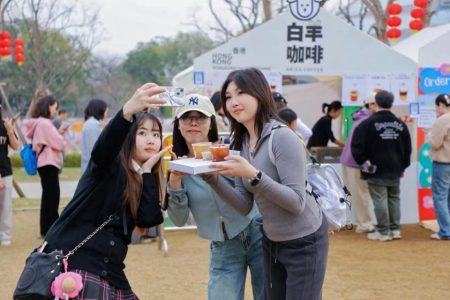


Traditionally, Lunar New Year (also called Chinese New Year or the Spring Festival) is celebrated with activities such as family dinners, the lighting of firecrackers and the handing out of red envelopes.
While these age-old customs remain integral to Chinese New Year, the festival has also sought to stay relevant by embracing more contemporary elements. One example of this is the watching of so-called Chinese New Year films, otherwise known as hè suì piàn (賀歲片) in Mandarin.
As the name suggests, Lunar New Year films are a category of commercial movies released during the holiday period. In keeping with the festive spirit, these movies tend to be light-hearted, feel-good productions dealing with themes such as family bonding, romance and good fortune.
Of course, not all such films adhere to this formula, as some merely earn the title of he sui pian by virtue of their release date coinciding with the holiday season.
[See more: Here are the top ten anticipated movies of 2026]
Take the Hong Kong film Protégé (2007) as an example. Released several days before the start of Chinese New Year, Protege was the anti-thesis of a traditional Chinese New Year flick, with its dark and sombre story of an undercover cop named Nick (Daniel Wu) bent on taking down the drug kingpin, Lam Kwan (Andy Lau).
Surprisingly, the film was a commercial success at the Hong Kong box office, defeating two rival local comedies by several folds by raking in HK$27 million in receipts.
With such an eclectic selection of films and a back catalogue spanning decades, picking out the perfect Chinese New Year films can be a chore. To help you out, we’ve compiled a list of eight flicks to enjoy this holiday season. Continue reading to learn more.
It’s a Mad, Mad, Mad World (富貴逼人)
Director: Clifton Ko
Origin: China (Hong Kong)
Release: 1987
Starring: Bill Tung, Lydia Shum, Eric Tsang, Elsie Chan, Loletta Lee
Wealth, prosperity and good fortune are integral parts of the Lunar New Year and nowhere is this better reflected than in the Hong Kong comedy film It’s a Mad, Mad, Mad World. Surprisingly, the film manages to capture the spirit of the festival without directly referencing the celebration at all.
The movie centres around a middle-class Hong Kong family consisting of Uncle Bill (Bill Tung), a TV anchor; his mahjong-playing wife, Aunty Lydia (Lydia Shum), and their three rebellious daughters. All five of them are cramped inside a public housing estate, although their fortunes shift dramatically when Aunty Lydia manages to win the lottery.
Central to the movie is the idea of whether money can truly buy happiness, with the family realising that their new found wealth may be more trouble than it’s worth.
Admittedly, It’s a Mad, Mad, Mad World neither pushes the envelope of cinema nor breaks new storytelling ground. For what it’s worth, the film is an amusing feature that’s good for cheap laughs and a look at Hong Kong during the 1980s.
Upon its release, Hong Kong audiences responded enthusiastically to the film, so much so that its box office surpassed the combined receipts of Hollywood’s RoboCop and Platoon. Its success resulted in the production of three sequels featuring the same characters and actors.
Director Clifton Ko would go onto helm other equally successful Chinese New Year films, including All’s Wells, Ends Well (1992) and It’s a Wonderful Life (1994).
All’s Well, Ends Well (家有喜事)
Director: Clifton Ko
Origin: China (Hong Kong)
Release: 1992
Starring: Leslie Cheung, Stephen Chow, Maggie Cheung, Sandra Ng,
All’s Well, Ends Well is arguably one of the most popular Lunar New Year flicks, remaining a perennial favourite among Chinese audiences even over three decades after its release.
Despite its name, this family-friendly screwball comedy bears no direct relation to the similarly named Shakespearean play. Both works, however, are linked by their light-hearted tone and focus on the themes of love and marriage, with the Hong Kong film juggling the stories of three brothers who must learn to successfully navigate the challenges in their love lives.
[See more: ‘Ballad of a Small Player’ is just the latest Macao casino movie. Here are 10 more]
With its wacky humour, feel-good themes and an all-star cast that includes pop legend Leslie Chueng and award-winning actress Maggie Cheung, the film was unsurprisingly a massive hit at the Hong Kong box office. Upon release, All’s Well, Ends Well became the city’s second highest grossing film in 1992, earning a total of HK$48.99 million.
The movie’s financial success spawned six sequels, although none of them managed to reach the lofty height of the original. As Fiona Law explained in an interview with Time Out, “the original All’s Well, End’s Well – people really think it’s a classic, the kind which can’t be made nowadays.”
The Wedding Banquet (喜宴)
Director: Ang Lee
Origin: US, China (Taiwan)
Release: 1993
Starring: Gua Ah-leh, Lung Sihung, May Chin, Winston Chao,
Although the Spring Festival isn’t technically featured in The Wedding Banquet, the film contains enough festive elements to make it perfect viewing for the holiday season.
The romance comedy centres around the character of Gao Wai-Tung (Winston Chao), a man living in New York who is in a gay relationship, unbeknown to his conservative parents in Taiwan.
Hoping to please them, Gao takes part in a sham marriage with a mainland Chinese woman desperate for a green card. However, matters take an unexpected turn when Gao’s parents travel to the US to witness their son’s “wedding.”
With gaudy scenes of a large family gathering in a restaurant draped in red, one could easily mistaken The Wedding Banquet for a film set during Chinese New Year.
“The banquet is the movie’s great set piece,” US film critic Roger Ebert rightly pointed out. “Booze and tradition and deception and exception all come together, and lead, in an unlikely way, to happiness.”
To top it all off, the movie also explores classic Spring Festival tropes such as family dynamics, love and generational gaps.
Those intending to watch the film with younger ones should take note that it features some nudity and sexual content. For a modern update, be sure to check out the well-received 2025 remake that shakes up the original story in unexpected ways.
Rumble in the Bronx (紅番區)
Director: Stanley Tong
Origin: China (Hong Kong)
Release: 1995
Starring: Jackie Chan, Anita Mui, Françoise Yip
Hong Kong action star Jackie Chan is no stranger to Chinese New Year releases, with at least a dozen such films to his name, including Dragon Lord (1982), Armour of God (1987) and Rumble in the Bronx (1995).
The latter is a classic fish out of the water story revolving around Ma Hon Keung (Jackie Chan), a Hong Kong cop who travels to New York to attend the wedding of his Uncle Bill (Bill Tung). Not long after arriving, Ma finds himself at odds with a local street gang, with the situation quickly spiralling out of control.
As with most classic Jackie Chan films, Rumble in the Bronx features his signature slapstick action comedy, as death defying stunts. The flick also holds a special place in Chan’s filmography, as it was his first feature to be marketed in the mainland as a Chinese New Year film, earning an impressive mainland box office of 9.5 million yuan in an era when tickets were just 10 yuan a pop.
[See more: 50 years of filming: 12 of the best movies filmed in Macao]
In fact, Shanghai Theatre Academy professor Shi Chuan told China Newsweek that prior to Rumble in the Bronx, mainland theatres would remain closed on the first day of the Lunar New Year, reopening only on the third day of the new year.
The movie’s success would end up opening the floodgates for Chinese New Year film releases, with mainland director Feng Xiaogang leading the pack.
Besides ushering in the modern era of Chinese New Year films, Rumble in the Bronx also introduced the general American audience to Chan, paving the way to his entry into Hollywood.
The Guardian Brothers (小門神)
Director: Gary Wang
Origin: China
Release: 2016
Starring: Gao Xiaosong, Baike, Yu Xinyi, Bi Xiaolan
The Guardian Brothers (also known as Little Door Gods) is the perfect Spring Festival flick for little ones, thanks to its cute animation style, heart-warming themes and easy-to-digest plot.
The film follows the Chinese door gods, Shen Tu and Yu Lei, who are at risk of unemployment as the technology-obsessed humans are no longer worshipping deities. Desperate to turn things around, Yu ventures into the human realm to unleash the monster Nian (年). Hot on Yu’s heels is his brother Shen, who teams up with a human girl to stop him.
Aside from its action-packed storyline, The Guardian Brothers also offers children a chance to learn about Chinese culture, as it makes various references to mythological characters and traditions.
For instance, the monster Nian is a reference to a legendary creature that would harass people during Chinese New Year. The story goes that people began lighting firecrackers, wearing red clothing and posting door couplets after figuring out that these were Nian’s weaknesses.
Although you can easily find an English dub featuring the voices of A-list celebrities such as Nicole Kidman and Meryll Streep, you’d be wise to watch the original Chinese version with subtitles, as the English version has been reedited, resulting in a watered-down version of the flick.
The Farewell (別告訴她)
Director: Lulu Wang
Origin: USA
Release: 2019
Starring: Awkwafina, Tzi Ma, Diana Lin, Zhao Shu-zhen
Family connection is one of the key elements of Chinese New Year and this is reflected vividly in The Farewell, a comedy drama based on the real life experiences of its director.
The film tells the story of Billi (Awkafina), a Chinese-American woman who finds out her grandmother is suffering from cancer and given just months to live.
[See more: ‘Loneliness and love are timeless themes.’ Meet Ding Tian of the Macao Classic Film Festival]
Much to Bili’s chagrin, her family decides to keep the cancer diagnosis a secret from her grandmother, instead opting to organise a sham wedding in China, so that all the family members can see the matriarch one last time.
Much like The Wedding Banquet, the film bears no direct relation to the Spring Festival. However, it manages to project many of the most fundamental parts of the holiday, including family gatherings, good food and filial piety. Of course, lurking beneath the surface is a deep and moving tale that meditates on life and death.
Hi, Mom (你好, 李煥英)
Director: Jia Ling
Origin: China
Release: 2021
Starring: Jia Ling, Zhang Xiaofei, Shen Teng, Chen He
Released on the first day of Chinese New Year 2021, Hi, Mom is currently the fourth-highest grossing movie of all time in China, with a worldwide box office of US$822 million.
Mixing elements of comedy, sci-fi and tear-jerker, the film tells the story of Jia Xialing, a woman who time travels from 2001 to 1981, where she befriends a young version of her deceased mother, Li Huanying. Various hijinks ensue as Jia tries to alter events that she considers to be regrets in her future mother’s life.
It’s not hard to see why Hi, Mom was so successful. Aside from a touching story of familial love that pays tribute to director Jia Ling’s real-life mother, the movie has some genuine laugh out loud and tearful scenes. Chinese audiences were also able to relive 1980s China through the film, thanks to genuine-looking sets and references to factory life and the rationing coupon system of that period.
Given Hi, Mom’s phenomenal success, Hollywood has unsurprisingly bought up the rights in the hopes of remaking the hit for an international audience. It remains to be seen if the English version will achieve the same level of acclaim, although it has director Jia’s blessing.
“I’m looking forward to this cooperation and I am so glad that my story with my mum can be shared with more people,” Jia said to Variety. “I believe that while everyone’s story with their mum is unique, the love in these stories is universal and something we can all resonate with.”
Wish Dragon (許願龍神)
Director: Chris Appelhans
Origin: USA
Release: 2021
Starring: Jimmy Wong, John Cho, Constance Wu, Jimmy O. Yang
Wish Dragon pays tribute to the mythological creature that has become a Chinese New Year symbol for prosperity and good fortune.
In some ways, the film can be viewed as a modern-day retelling of Aladdin set in Shanghai, as it follows similar plot beats. Much like Aladdin, the story follows a down-on-his-luck man, who is desperate to impress a girl by making wishes. Wish Dragon, however, replaces Aladdin with a university student named Din Song and the genie with a wish-granting dragon trapped in a magical teapot.
Directed by Chris Appelhans, one half of the pair behind the smash hit KPop Demon Hunters (2025), Wish Dragon received mostly positive reviews from critics who praised it for being enjoyable, even if it treading familiar ground.
[See more: The 8 red envelope rules of Chinese New Year]
“A simple, cute, unoriginal animated film that seldom impresses, but still warms your heart a little,” Joseph Stanichar wrote in a Paste Magazine review.
It also helps that well-known Asian-American celebrities, including Jimmy Wong, John Co and Constance Wu, lend their voices to the English version. Meanwhile, Jackie Chan produced the movie, in addition to voicing the dragon in the Mandarin dub.
Currently, a sequel is in the works, with a release date set for summer 2027.