
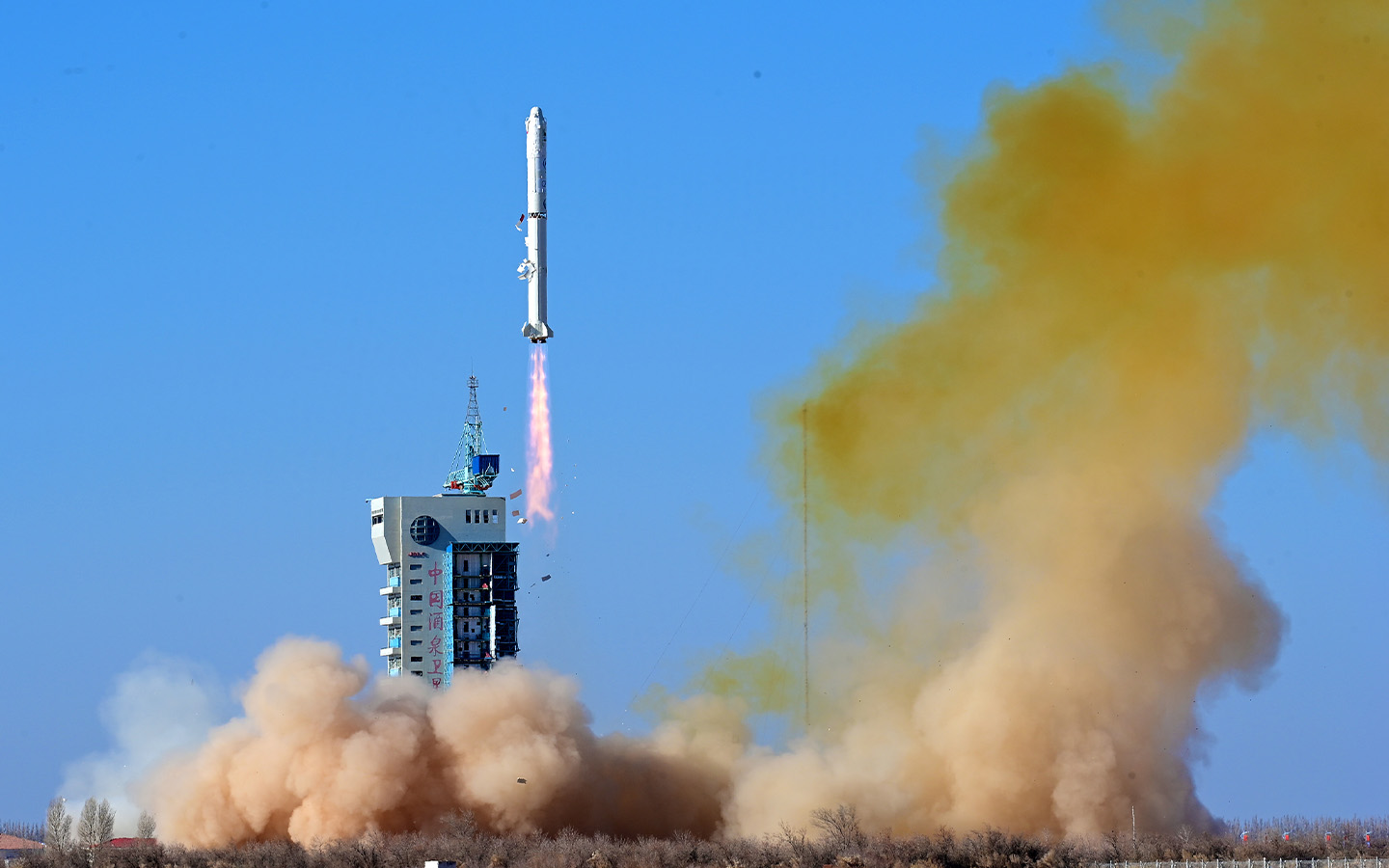
China’s first low-latitude remote sensing and communication integrated satellite network is set to take flight this year with the launch of three pioneer satellites, reports Xinhua.
Jointly launched by Guangzhou University, the Guangzhou Municipal People’s Government and the State Information Centre, the Wuyang Constellation project aims to construct a space-based information service system covering the areas between 35° north and south latitude, where there is a gap in current coverage.
Gu Xingfa, chairman of the Chinese National Committee for Remote Sensing and a professor at Guangzhou University, touted the project as a “Guangzhou solution” for the development of commercial aerospace in the city, province and Greater Bay Area. The low-latitude focus will cover the GBA, as well as much of Southeast Asia, Africa and South America, creating a new spatial information corridor along the 21st Century Maritime Silk Road.
The Wuyang Constellation, Gu explained, will carry high-resolution, wide-swath full-spectrum payloads to build a “material fingerprint” spectral database, upgrading remote sensing capabilities from “taking photos” to “high-precision physical measurements.”
It will serve government emergency response, ecological monitoring and agricultural applications across low-latitude regions with “instant sensing, instant transmission and instant use” intelligent services. Extreme weather events could be monitored with near real-time updates, while remote sensing data, combined with communication services, could support smart city initiatives and maritime safety.
[See more: Guangdong hosts launch of world’s first AI satellite for smart cities]
This ambitious project starts with launching the first of three pioneer satellites, scheduled for mid-2026, to validate key technologies and application models. Between 2026 and 2028, the developer will build 25 application satellites to achieve daily full coverage of low-latitude areas, enabling a 30-minute emergency response capability. The next step will see the establishment of a 1,008-satellite commercial network by around 2035, to create a real-time remote sensing system for global low-latitude regions.
Coverage will gradually expand with each phase, eventually including 15 southern Chinese provincial-level regions and 99 low-latitude countries and regions around the globe.
Nearly two dozen core enterprises have signed agreements to participate in related satellite development and data services.
The Wuyang Constellation project has also established a commercial space innovation centre in the heart of the GBA, integrating research, incubation, application and investment. By 2030, the project aims to achieve over 95 percent real-time remote sensing coverage in low-latitude areas, driving more than 10 billion yuan (US$1.45 billion) in industrial investment.