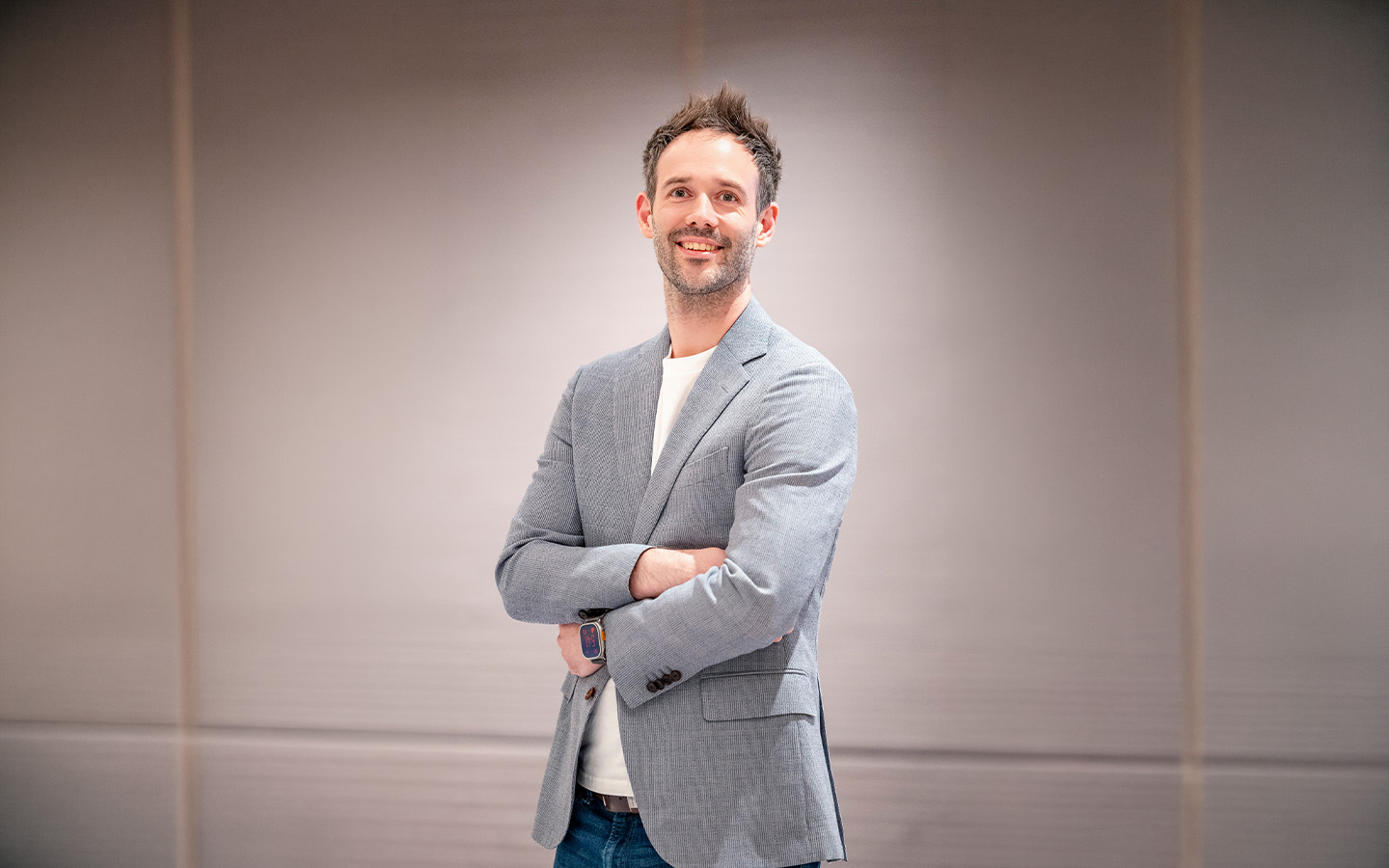
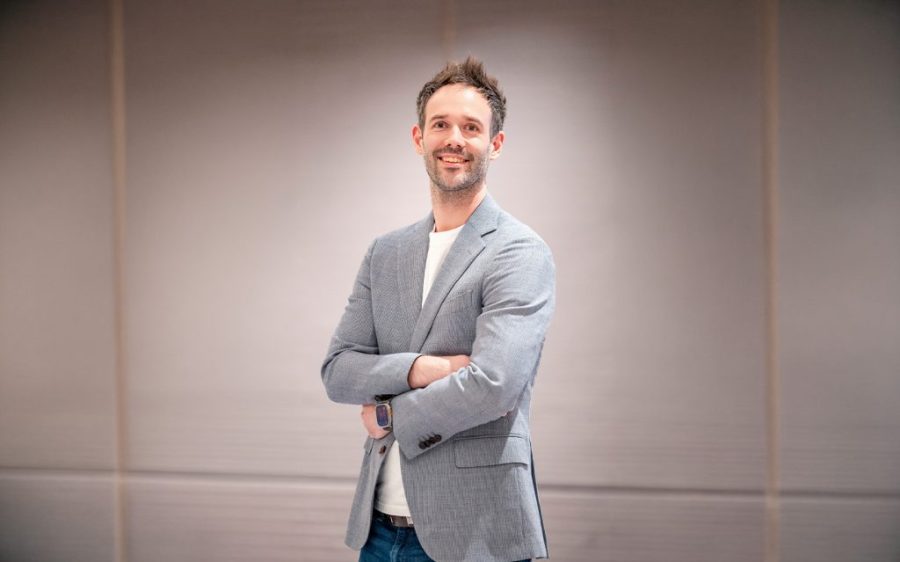
Moritz Berrenberg isn’t your typical Greater Bay Area (GBA) entrepreneur. Aside from managing his Dongguan-based electric motors development and manufacturing firm Maxmore Technology, the German native also moonlights as a racecar driver, having completed his first full season as a professional in 2024.
Last year, Berrenberg took his self-described “hobby” to the next level by finishing two full seasons, including the 2025 China GT season finale in Shanghai, which saw him sweep all three championship titles.
Although Berrenberg finds personal satisfaction in racing, the German driver admits that there is a business-side to it too.
“It’s also for our product development because we are building race simulation products,” he says – items that include the motors behind video game steering wheels. “This helps me to understand how the wheel of the car can work better to make the simulation or gaming products more realistic.”
[See more: GBA Voices: How Hong Kong entrepreneur Ashley Dudarenok learned to decode China]
Beyond the sim racing equipment, Maxmore Technology is also involved in a host of other industries, collaborating with European clients in sectors as wide-ranging as medicine, space, aviation and e-mobility.
All this is a far cry from when Berrenberg first established Maxmore Technology in 2003. At the time, the motors manufacturer was still a small German-based trading company focused on computer and hardware products.
Looking to enhance the quality of his products, Berrenberg moved Maxmore Technology’s headquarters to Shenzhen before finally settling in Dongguan for good in mid-2006. The company underwent a seismic shift in 2014, transforming from a trading company into an electric motors design and manufacturing firm.
The Bay spoke with Berrenberg to find out the reason behind Maxmore Technology’s evolution and to hear his views on doing business in Dongguan and the GBA.
This interview has been edited for brevity and clarity.
How did Maxmore Technology move from trading into manufacturing?
We do products for electric scooters, electric motorbikes and electric bicycles. I had one client who needed an electric motor for his new e-bike and he asked me to find a supplier in China who could make this motor for him in China. I was looking for a really long time, but I could not find a single motor company that would be capable of building this motor with the quality requirements that the customer had.
I decided to study more about it – how to make these things, the machinery and manufacturing methods and everything. I decided I could do the motor myself.
At that time, my company was also smaller, so the investment cost was almost half a million euros to get it going. The unit price I gave the client was attractive, but he hesitated to give this order all the time because I was not a motor manufacturer. I was still a trading company at that point.
After half a year, he still hadn’t decided to give me the order. I flew over to Germany, met and had dinner with him and told him, “I’m so confident I can do this motor for you. I’m going to do all the investments of our own machinery. I’ll pay for all the toolings and will just make this motor for you. If my motor is better than the one you’re currently purchasing from Germany, then you have to purchase the motors from me in the future.”
We did a handshake deal on that and I set up my factory, got some machinery and built the first motors all myself. After the first motors were completed, I flew back to Germany with them, tested them and they were better than the existing motors. He gave me the orders and I became a factory in 2014.
[See more: GBA Voices: Macao architect Christine Choi on doing business in the Greater Bay Area]
What is the manufacturing sector in Dongguan currently like?
It really depends on which industry you are in. The high-tech sector is doing pretty well, but the traditional manufacturing companies like textile and furniture – all the labour intensive industries – are moving away from Dongguan [to lower labour cost countries like Bangladesh and Myanmar] and are having a tough time.
There’s also so many environmental regulations for environmental protection, so they’re all moving away. But for high-tech companies, the government really supports them.
How has the rise of the electric vehicle market in China affected your firm?
It has not really impacted me very much because most of my clients are not automotive clients. We do not really serve the car industry because their profit margins are really, really tiny. We prefer industrial, aviation, medical, gaming or consumer industries because it’s not such a high cost pressure like in the automotive market.
Which Chinese government measures has Maxmore taken advantage of?
First of all, high tech companies in China have a reduced profit tax of only 15 percent instead of the 25 percent that is the China-wide standard. We get subsidies for some new machine investments, or if you need space or anything else, they’re always there to help. If you need to get some approvals done, they’re really supportive in all of these things.
How easy is it to secure parts and supplies in Dongguan?
Really easy. The supply chain is one of the biggest advantages to being located in Dongguan because I can get everything I need within a one hour drive. Most of my suppliers are located within a one hour drive around my own factory.
Dongguan, especially China, is a really strategic choice for my factory and for the electric motor industry because in politics, you hear a lot about rare earth metals [most of which are produced and processed in China]. Electric motors, especially the kind we are doing, need a lot of rare earth magnets. Of course, we have no problem at all getting them within China. If your factory were outside of China, you would have quite big challenges these days to actually secure the raw materials you need to make high-end electric motors.
Are there any challenges to doing business in Dongguan?
Mainly finding high-end talent, which is more difficult to recruit in Dongguan than compared to Shenzhen. That is the only thing I would consider a challenge for Dongguan since the business environment is pretty good over there.
[See more: How the Greater Bay Area is turning cities into weekend destinations – and why Macao is benefiting]
Which city in the GBA has Maxmore been recruiting its talent from?
Shenzhen, but often the people in Shenzhen are not willing to move to Dongguan when they like Shenzhen so much. Basically, Shenzhen is the biggest talent pool where you can recruit talent from.
The other pool is Germany because I also set up an R&D Centre in Germany to recruit talents over there because sometimes talents in Germany are the same price or even cheaper than in China these days. At the same time, we protect some of our IP because it is more difficult for the competitors to take away your German key people compared to the ones located in China because in China, it is really common for people to go try to take your employees away with a much higher salary if they want to get the knowledge.
Has the current economic environment and tariffs impacted your company at all?
Yes, certainly because we have some clients in North America as well. Of course, the orders are less from North America compared to before, and it’s not really a market we would like to focus on so much because it’s really uncertain with the policies and everything that’s going on there.
Our main market is Europe and for the year, we do not have any tariff problems with Europe. The only issue for us is the European economy is not doing that great.
Gas will also affect a little bit of our business, but we have a lot of rising industries. We supply the robotics industries with products like motors and the market is growing. Drone motors are growing. In a lot of industries, even though the economy is not good, the industries themselves are growing.
[See more: First-time visitor to the Greater Bay Area? Here are 8 travel tips]
What do you think is the key to success for an overseas manufacturing company that’s looking to get into the GBA?
Take advantage of all these supply chains, because that is the biggest advantage. You’re getting materials so fast and everything is so short, so you can reduce the product development time by magnitudes of three to four times compared to Europe. You’re getting parts from everywhere so fast, you don’t have all this idle waiting for parts to come in, which would take forever in Europe if you’re building new products.
Come to China if you want to reduce your time to market. Basically, develop the product here, make them here and it will just reduce the time to market by a factor of three.
Where do you see the GBA 10 years from now?
I think the government will probably envision it as a really concentrated powerhouse, with Guangdong, Hong Kong and Macao all integrated. Right now, it’s already so convenient to travel between all the cities.
In 10 years, or maybe even in five years, from my factory in Dongguan, I’ll be able to hop into a drone and fly over to Macao or Hong Kong within a few minutes. I think it’ll be super connected – one really huge metropolitan centre where you can go from point A to B everywhere within 15 minutes. All the high-tech development is going to happen here in China.
GBA Voices is produced in partnership with EO Greater Bay Area Metropolitan