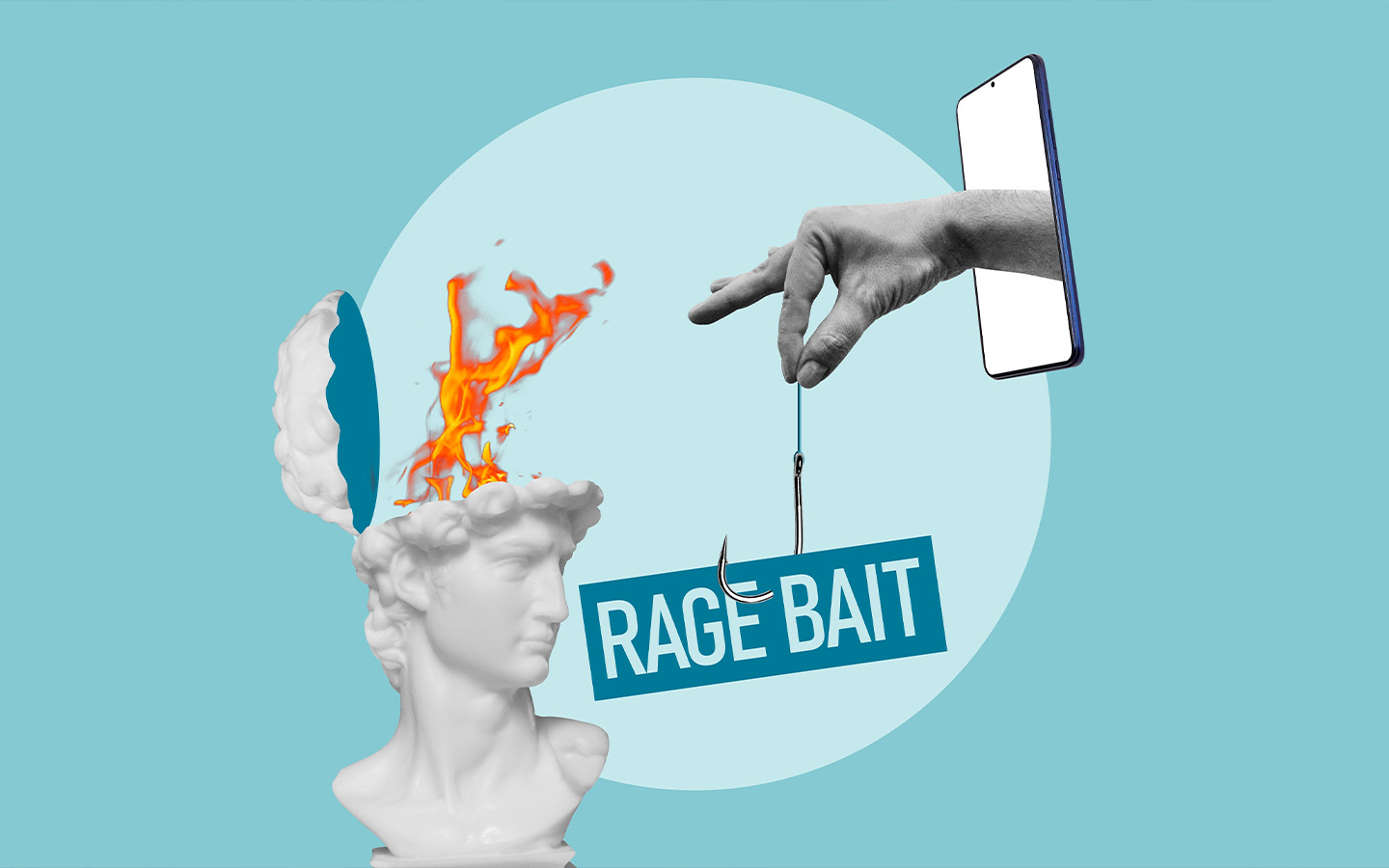
Oxford’s Word of the Year is ‘rage bait’, capturing the increasingly toxic landscape of our online world, where deliberate provocation monetises our outrage and undermines trust.
Even if you don’t know the term ‘rage bait’, anyone who’s been online in the last decade is painfully familiar with it in practice. Oxford defines it as online content deliberately designed to elicit anger or outrage by being frustrating, provocative, or offensive, typically posted to increase engagement or site traffic.
Use of the term increased threefold over the last 12 months, evolving to signal a deeper shift in how we talk about attention, engagement and ethics online. Engagement-driven algorithms and the increasing monetisation of social media platforms have fuelled the rise of “rage-farming,” with creators more consistently manipulating reactions and building anger over time by lacing their content with rage bait, often through deliberate misinformation and conspiracy theories.
“The fact that the word rage bait exists and has seen such a dramatic surge in usage means we’re increasingly aware of the manipulation tactics we can be drawn into online,” reflected Casper Grathwohl, president of Oxford Language.
[See more: ‘Skibidi’ and ‘delulu’ are now in the Cambridge Dictionary]
The term first emerged online in a posting on Usenet in 2002 to describe a real-world phenomenon of one driver deliberately provoking another by flashing their lights as a request to pass – the “bait” into road rage. Over time it evolved into internet slang for viral tweets before becoming shorthand for content tailormade to provoke anger by being frustrating, offensive or deliberately divisive.
The rise of rage bait marks a shift from its cousin, click bait, trading in misleading headlines meant to grab our attention for those intended to hijack our emotions. “It feels like the natural progression in an ongoing conversation about what it means to be human in a tech-driven world – and the extremes of online culture,” Grathwohl said.
“Where last year’s choice, ‘brain rot’, captured the mental drain of endless scrolling, ‘rage bait’ shines a light on the content purposefully engineered to spark outrage and drive clicks,” Grathwohl explained. “And together, they form a powerful cycle where outrage sparks engagement, algorithms amplify it, and constant exposure leaves us mentally exhausted.”