
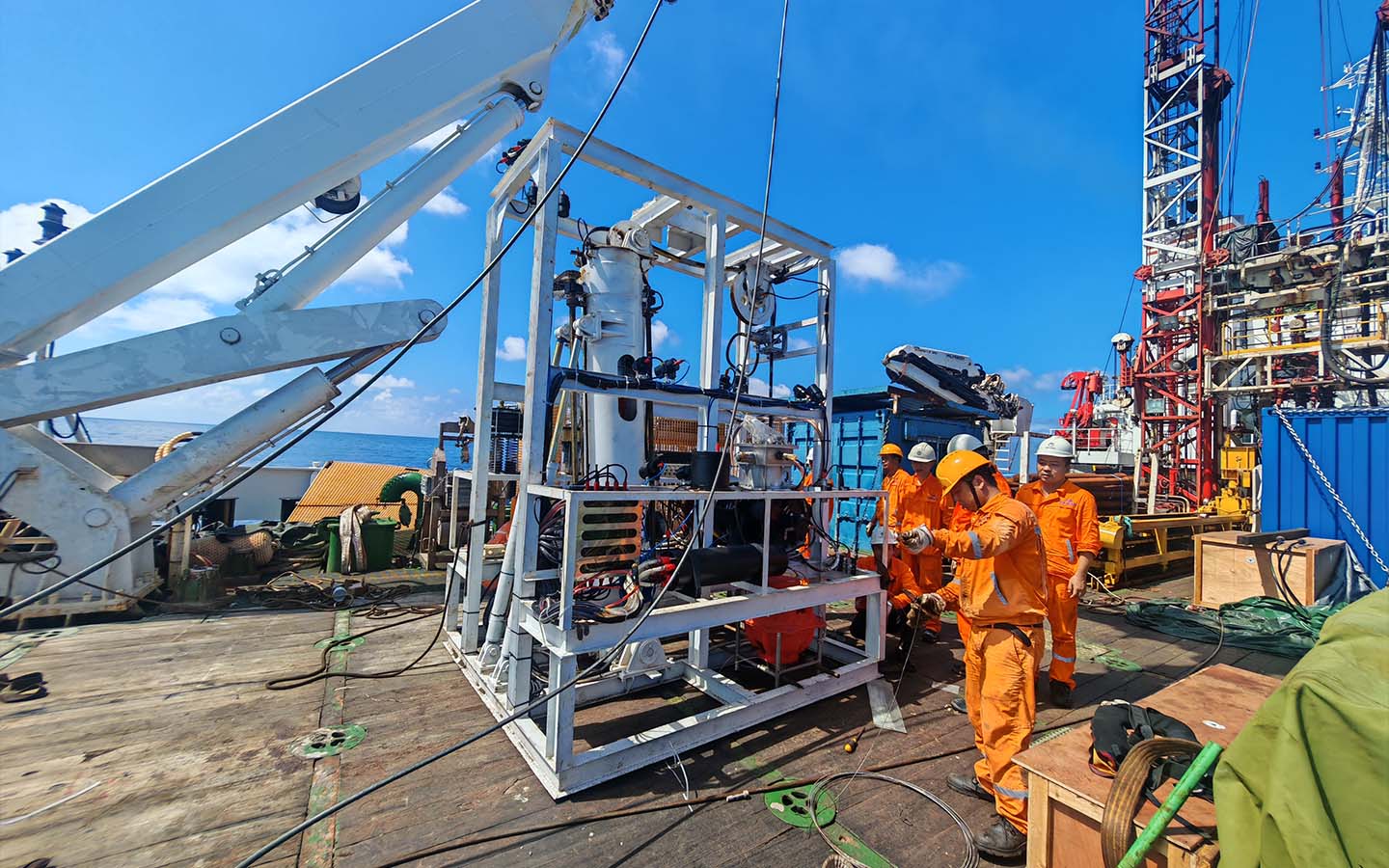
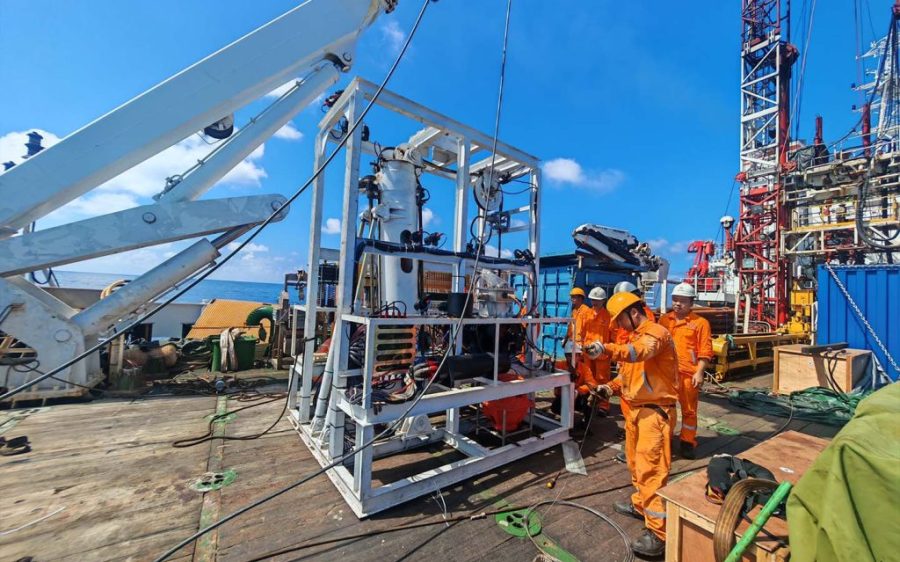
China has successfully completed a trial operation of its first domestically developed undersea robot capable of three-dimensional drilling and in-situ monitoring within seabed strata, Xinhua reported last week.
The robot, developed by the Guangzhou Marine Geological Survey (GMGS) under the China Geological Survey, completed tests at a depth of 1,264 metres in the South China Sea – achieving all performance targets set for the mission, according to GMGS.
Engineer Zhu Yangtao, the project’s deputy leader, said the robot was capable of “drilling freely and positioning itself accurately inside deep-sea formations” while navigating around obstacles like rocks and biological debris. It could also plan its own optimal paths during operations.
Equipped with multiple sensors, the robot conducted real-time in-situ monitoring during the trial, collecting more than 2,000 data sets covering methane concentration, dissolved oxygen levels and stratigraphic structure, Zhu said. He noted that the data would be used to assess geological conditions in the test extraction zone.
[See more: China’s ‘jellyfish robot’ promises to be a breakthrough in deep-sea exploration]
While deep-sea strata are known to contain resources such as gas hydrates, rare-earth elements, and polymetallic nodules, exploration is complicated by extreme conditions including high pressure, low temperatures and geological instability. Existing technologies often face limitations in mobility, coverage and real-time data transmission, according Zhu.
To address these challenges, GMGS independently developed key technologies for the robot, which features a modular design and integrates inertial navigation, magnetic beacon-assisted positioning and AI algorithms to improve adaptability to complex environments.
The team said further improvements were planned to enhance the robot’s performance for use in even more complex conditions. It is expected to be deployed in future deep-sea resource exploration projects and scientific drilling programmes.