Guangdong province’s local government has outlined a strategy to be the “main force” and “driver” of the integrated development within the Greater Bay Area (GBA). That’s according to recommendations released on Monday for drafting the province’s 15th Five-Year Plan for National Economic and Social Development (2026 to 2030), reported by China Daily.
The blueprint says Guangdong will work with Hong Kong and Macao to turn the 11-city cluster into an innovation and industrial hub through focusing on infrastructure connectivity, alignment of the three regions’ rules and mechanisms, and closer people-to-people exchanges.
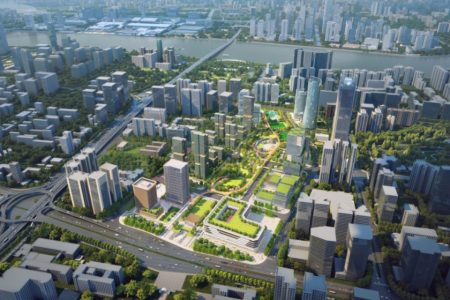
Key cooperation zones like Qianhai, Hengqin and Nansha were identified as priorities for regional coordination, with the province seeking to strengthen their pilot roles in policy implementation, reform and major project development.
In Hengqin, Guangdong’s plan is to accelerate integration with Macao. Measures include improving the “separate line management” system and speeding up development of emerging industries supporting Macao’s economic diversification.
[See more: The GBA is only in third place nationally when it comes to hosting ‘pre-unicorns’]
According to Zheng Yongnian, the Chinese University of Hong Kong’s School of Public Policy director, the GBA has the potential to become the world’s biggest economic hub and a global leader in science and technology innovation by 2035 if effective integration can be achieved.
That integration process comes with challenges, warned Dai Zhipeng, an assistant professor at Shenzhen MSU-BIT University’s Faculty of Economics – particularly around cross-boundary recognition of professional qualifications, financing and data flows.
“Cross-boundary integration not only involves regulatory frameworks and service standards, but also social and administrative systems,” he said. “At the heart of breaking down development barriers lies the alignment of systems and rules.”