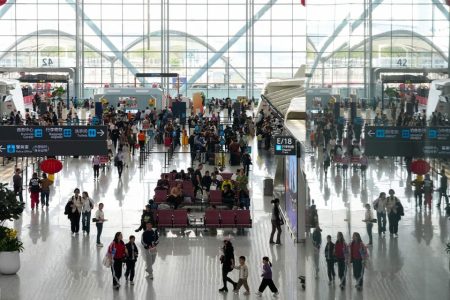
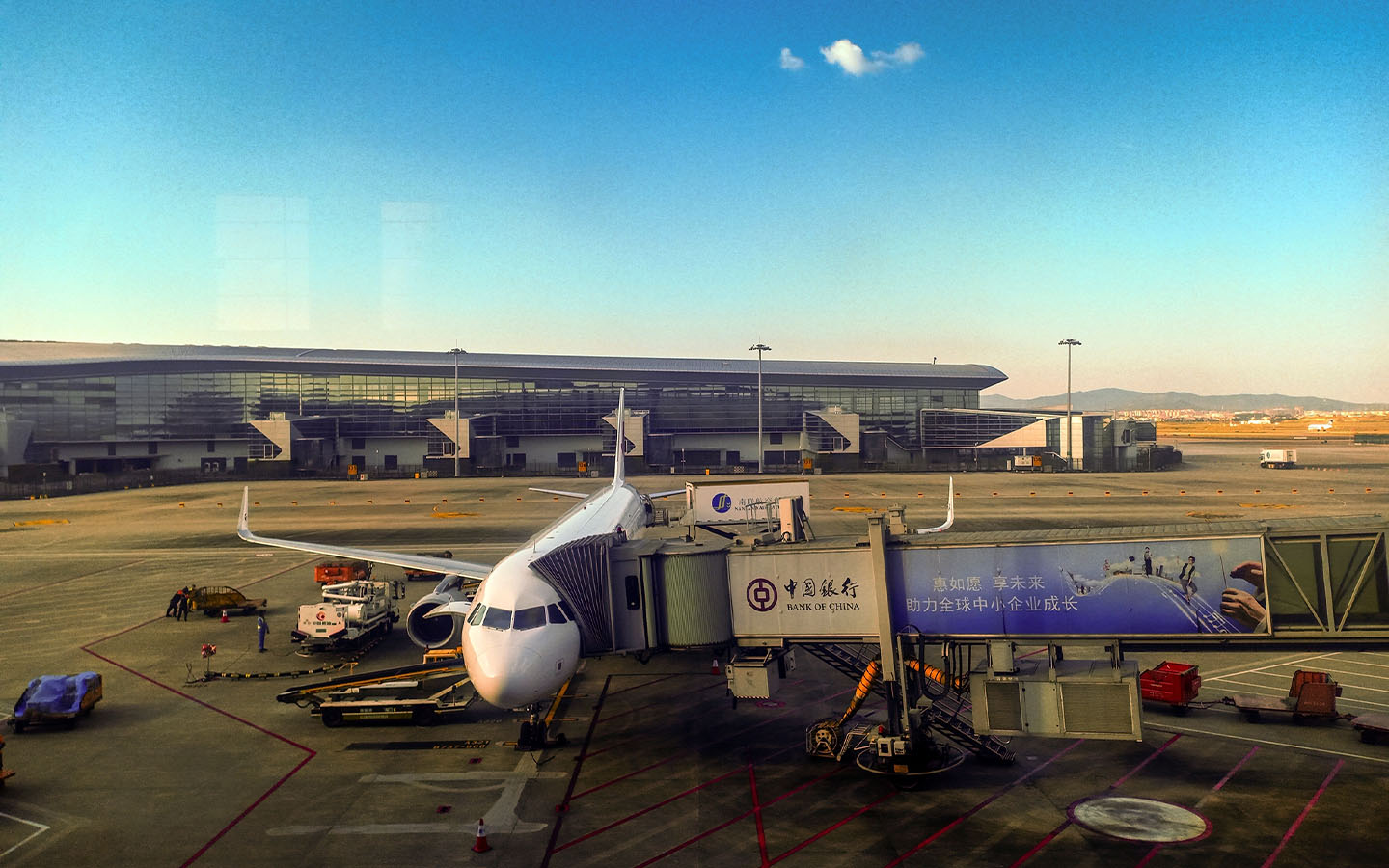
Several airports across the Greater Bay Area (GBA) recorded a sharp rebound in air travel and freight activity in 2025, with the regional airport cluster handling more than 230 million passenger trips and about 9.72 million tonnes of cargo and mail in total.
The figures place the GBA among the world’s leading aviation hub groups, according to state media citing recently released operational data from seven major airports in the region. “Among the world’s four major bay area airport clusters, the Guangdong-Hong Kong-Macao GBA cluster leads in terms of transport volume,” it noted.
The three core hubs within the cluster performed particularly well. Guangzhou Baiyun International Airport set new records last year, processing 83.59 million passengers – a year-on-year rise of 19.8 percent – and 2.44 million tonnes of cargo and mail. So did Shenzhen Baoan International Airport, handling 66.49 million passenger trips and 2.05 million tons of cargo and mail – up 8 percent and 9 percent, respectively.
Hong Kong International Airport reported 61 million passengers, up 15 percent year-on-year. Hong Kong’s 2025 cargo volume grew to 5.07 million tonnes, a 2.7 percent increase.
[See more: Macao’s airport battles headwinds with strong international route growth in 2025]
Smaller airports in the region also saw gains, with Zhuhai and Huizhou clocking year-on-year cargo and mail increases of 15 and 25 percent respectively. Macao, meanwhile, recorded a more modest increase of 1.08 percent. The SAR also experienced a 1.6 percent decrease in total annual passenger traffic, compared with 2024.
GBA airports’ overall growth has been underpinned by the region’s economic scale and export-oriented industrial base. With total economic output expected to exceed 15 trillion yuan in 2025, the region supports high-value industries such as semiconductors, biopharmaceuticals, new-energy vehicle components and high-end electronics, all of which rely heavily on fast and reliable air freight. Cross-border e-commerce has also contributed to demand, with platforms like Shein and Temu increasing the need for high-frequency, time-sensitive air logistics, including dedicated cargo routes and charter services.
Another factor is China’s visa-free roll-out, which saw the number of foreign nationals entering the country at Shenzhen airport surge by 133 percent for the first 11 months of 2025, when compared to the same period in 2024.
The GBA’s airport cluster consists of its three core hubs, two trunk airports in Zhuhai and Macao, and two feeder airports located in Huizhou and Foshan. Its route network covers more than 200 cities worldwide.