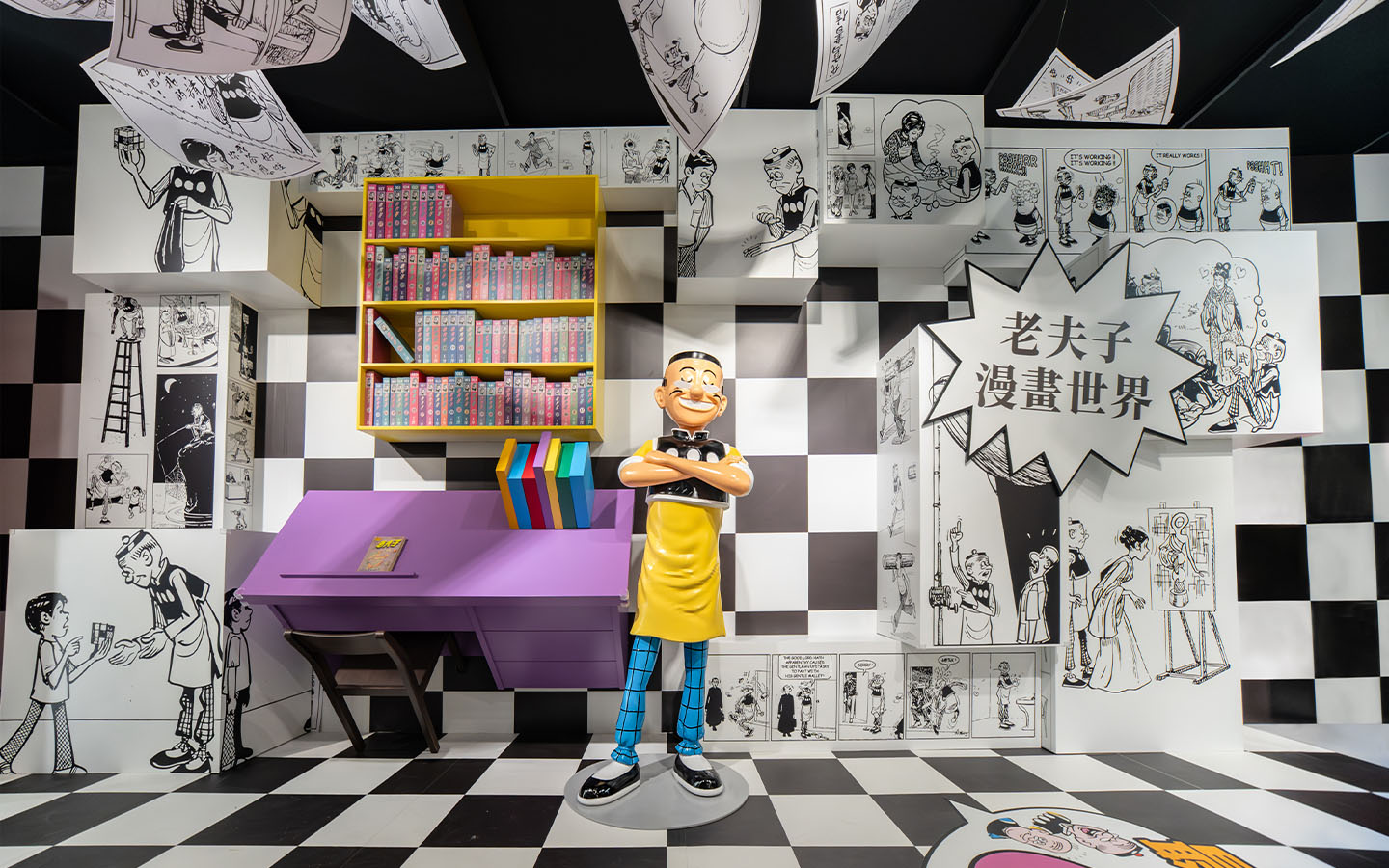
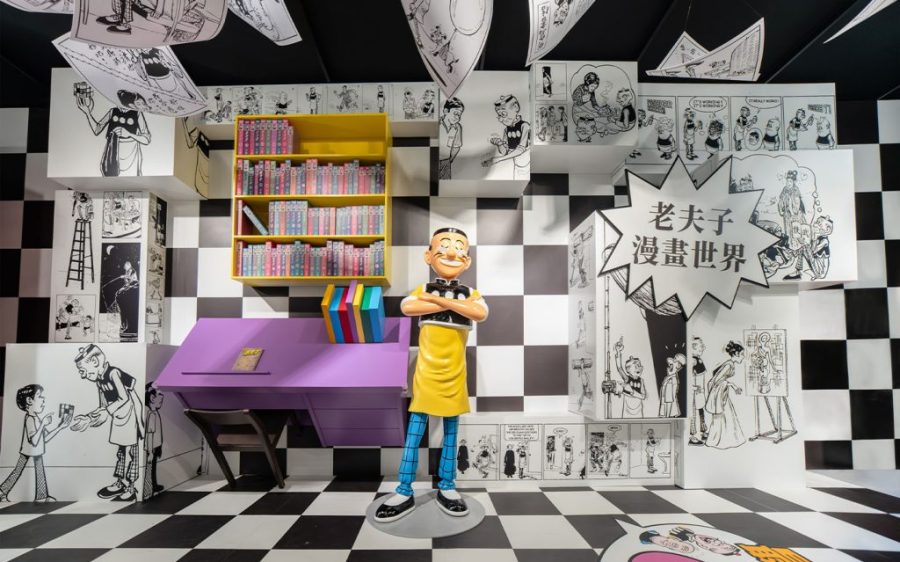
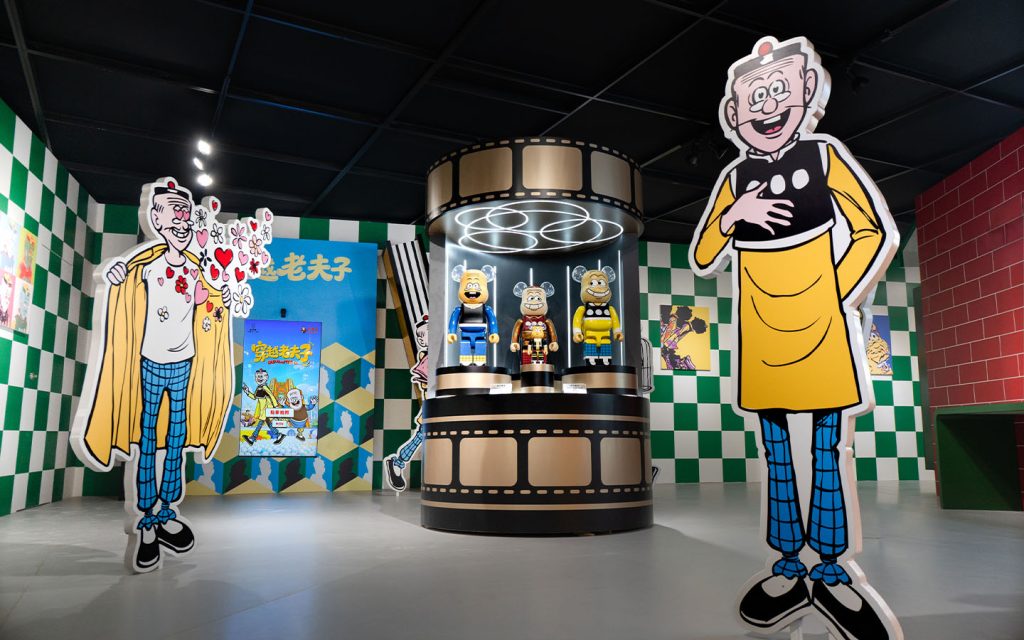
A brand-new exhibition celebrating the iconic comic strip Old Master Q (老夫子) has just opened at Studio City in Macao. The Old Master Q 60th Anniversary Fantastic Journey – Macau Special Exhibition features pre-publication prototype manuscripts, early sketches, a walk-through immersive experience, and an interactive installation for guests.
For anyone in Hong Kong, or Asia for that matter, the iconic comic strip is immediately recognisable. Led by the antics of a middle-aged man donning his signature three-button Chinese garment, Old Master Q, alongside his friends Big Potato (大番薯) and Mr. Chin (秦先生), has entertained readers for more than 60 years by navigating the complexities of everyday life.
But the comic strip offers more than just visual humour. The new exhibition celebrating its enduring popularity features unintentional economic truths subtly woven into the vignettes. With minimal dialogue, the storylines rely on visual humour that often present themselves as mini-allegories, and when the sketches were first introduced in the early 1960s, they commonly satirised Hong Kong’s economic transformation, connecting with a regional audience.
[See more: Meet the Macao police officer sketching a unique path in the comic world]
The manner in which each character responds to evolving circumstances commonly illustrates core economic principles being applied to everyday life, says Sam Ng, research assistant professor of economics at the University of Macau, speaking with The Bay.
While these qualities are not exclusive, the Old Master Q cast also embodied irrational behaviours, portraying a striking juxtaposition to modern economic principles and opening learning opportunities for those less familiar with economics’ main theories, Ng says.
Here are some of the economic axioms discernible from a study of Old Master Q.
The three functions of money
Fans of the franchise know that Old Master Q is no stranger to a free meal. His frugality is central to his relatability, gaining popularity at a time when few owned a television set and newspapers provided affordable entertainment. Money, a foundational concept in economics, shapes how, and what decisions are made.
Yet, for money to be money, it must fulfil three essential roles: serving as a medium of exchange, a store of value, and a unit of account. In a situation where Mr. Potato bakes a cake and wants to swap it for a haircut from Mr. Chin, the exchange will not take place if the recipient has no interest in the offered item. “As a medium of exchange, money eliminates the double coincidence of wants, a foundational concept that reduces trade friction,” Ng explains.
[See more: A life in chapters with Macao illustrator Yang Sio Maan]
Money’s other functions, as a store of wealth and unit of account, rely on the credibility of the monetary authority issuing them, a definition commonly used to contrast with cryptocurrencies that derive their value from decentralised blockchain networks rather than sovereign backing.
“The acceptability of money rests on the expectation that it can be used in the future to procure goods and services, thereby removing barriers to exchange,” Ng remarks. However, this does not always resolve the ambiguity surrounding trust in future value or acceptance.
Cost-benefit analysis

Because Old Master Q comics were typically depicted in fewer than six story panels, episode outcomes were quickly reached. “Every day, we make an infinite number of decisions, weighing the pros and cons of each,” says Lai Chong Au, group chief executive officer at Delta Asia Financial Group.
“In economics, this is simply cost-benefit analysis where we envision the positives outweighing the negatives,” she notes, adding that much of this judgment comes down to how we allocate our resources to reach the best possible result.
In one storyline entitled Dying for Money, Old Master Q is hit by a car and is immediately compensated by a sympathetic driver. Linking the two events, he decides to jump in front of another vehicle, with the final panel showing a coffin being loaded into a hearse.
[See more: From graffiti to grand murals, Vitorino Vong’s art transforms Macao]
Opportunity costs, which represents the value of what is given up in pursuit of something else, is factored in cost-benefit analyses. If Old Master Q purchases flowers for Miss Chan instead of going to work, the opportunity cost is the lost salary from that choice, making the true cost from an economic perspective greater than the price of the flowers alone.
This concept is featured in Think Twice Before You Leap, when Old Master Q is seen taking a stroll with a young lady when a thought bubble appears. Images of marriage, a banquet, and family, along with their associated costs, emerge, leading to the final panel showing Old Master Q running away.
“Unfortunately for the young lady, Old Master Q decided that the immediate benefit of dashing off exceeded the future cost of sticking around,” Au says.
Zero-sum economics
The stories of Old Master Q often illustrate the zero-sum principle, in which one party’s gain is offset by another’s loss, producing no new value but merely redistributing existing profits, UM’s Ng explains. This terminology has been used among economists who argue that tariffs achieve a zero-sum effect, where the perceived revenues from higher levies are offset by reduced gains, such as higher consumer costs, elsewhere.
[See more: US retail giants like Walmart will bear some costs of Trump’s tariffs, report says]
In Prunnin, Big Potato notices a bouquet of flowers sprouting above his hedge. Wanting a neatly trimmed bush, he cuts the pedals away, but in doing so, he severs the bloom Old Master Q was presenting to a young lady. Big Potato ends up with a clean hedge, while Old Master Q is left without his flowers, drawing a gain coming at the expense of the other.
Edutainment
This discussion is by no means exhaustive. Additional principles, such as game theory and sunk costs, also appear frequently in Old Master Q comic strips. With their limited dialogue and exaggerated antics, these stories invite nearly endless interpretations. Yet entertainment remains central to Old Master Q’s enduring popularity.
Those looking to reconnect with Old Master Q beyond this field study will find more at the Studio City exhibition. It features a walk-through immersive experience and a pop-up store showcasing the comic strip’s beloved cast. Further details are available here.