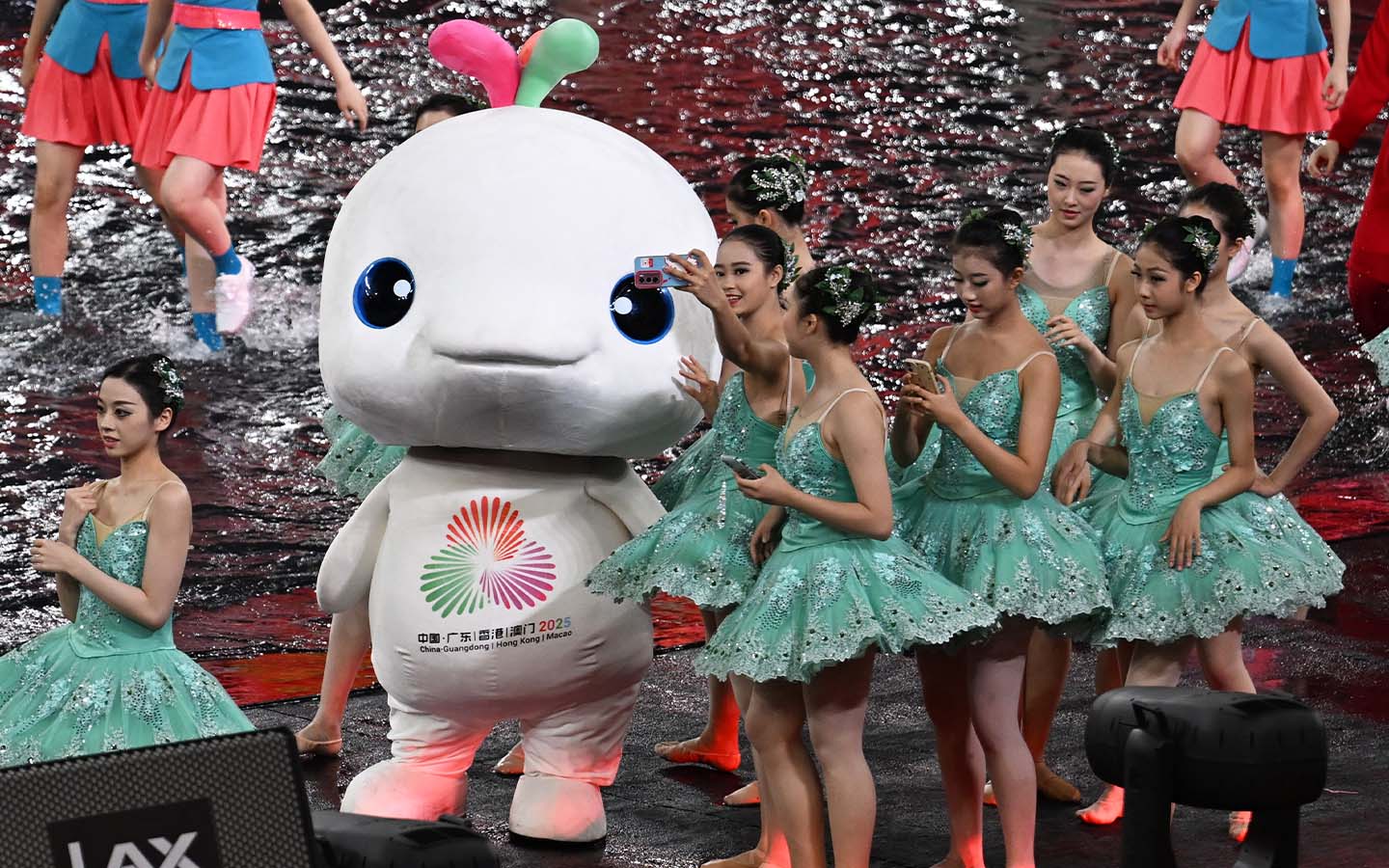
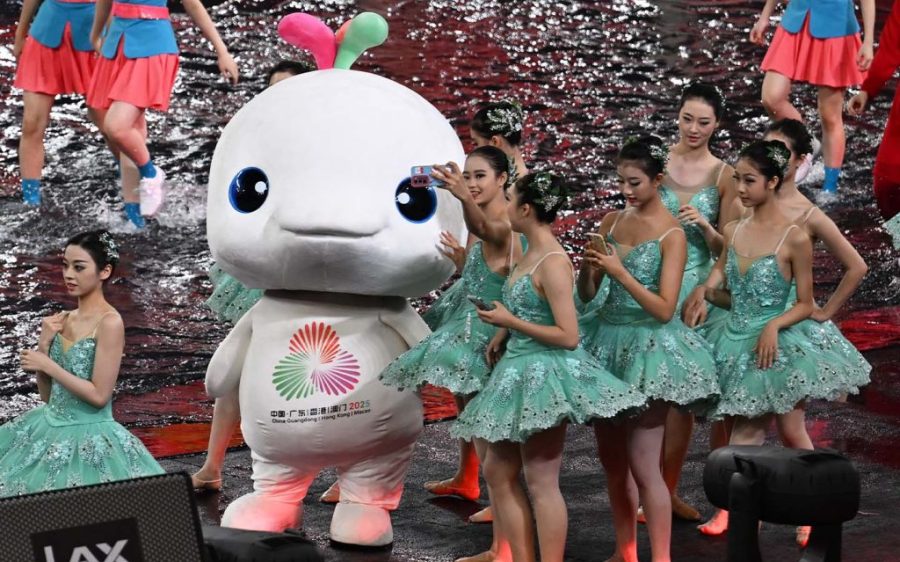
What began as the official mascots of China’s 15th National Games have quickly evolved into one of the most recognisable symbols of the Greater Bay Area.
Unveiled in November 2024, Xiyangyang and Lerongrong were introduced as the official mascots of the Games, which were jointly hosted by Guangdong, Hong Kong and Macao for the first time. Modelled on the Chinese white dolphin – a protected species native to the Pearl River estuary – the characters were designed to reflect ecological heritage and regional unity.
Within days, however, online users in the Greater Bay Area mistook the dolphins for birds and gave the mascots a new identity: the “Greater Bay Chicks.”
[See more: China rebounds from early setbacks with three-gold surge at Milano-Cortina 2026]
The nickname spread rapidly across Douyin, Weibo and Xiaohongshu, where videos featuring the mascots accumulated hundreds of millions of views. Retail demand followed, with licensed plush toys and related merchandise reportedly selling strongly in mainland cities ahead of and during the Games.
The episode highlights how a regional branding exercise can take on a broader cultural life, particularly when amplified through social media.
Designed to represent a region
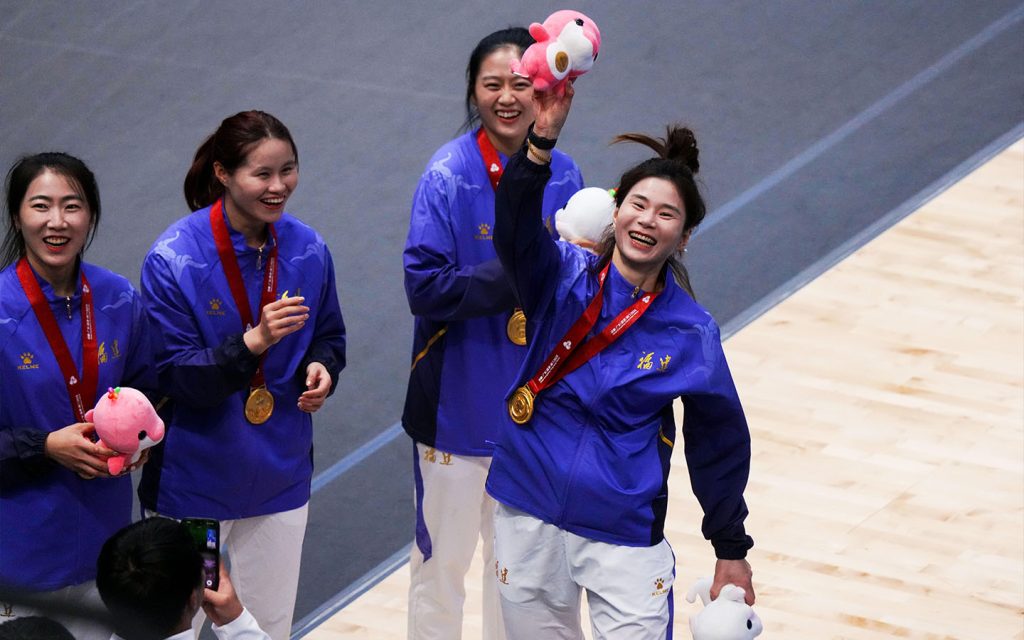
Organisers have emphasised that the Greater Bay Area mascot carries layered symbolism. The Chinese white dolphin is often described as the “giant panda of the sea,” making it an ecological emblem of the Pearl River Delta.
The mascots’ heads feature three coloured water jets – red, purple and green – representing the flowers associated with Guangzhou, Hong Kong and Macao. When viewed from the front, the shapes form a heart, symbolising cooperation among the three host regions.
The 15th National Games marked a milestone for the Greater Bay Area initiative, which links 11 cities, including Hong Kong, Macao, Guangzhou and Shenzhen, into a coordinated economic cluster frequently compared to other global bay areas.
While policy discussions around the Greater Bay Area often centre on infrastructure, finance and technology, the mascot has offered a more accessible visual shorthand for the idea of integration.
From sports branding to cultural IP
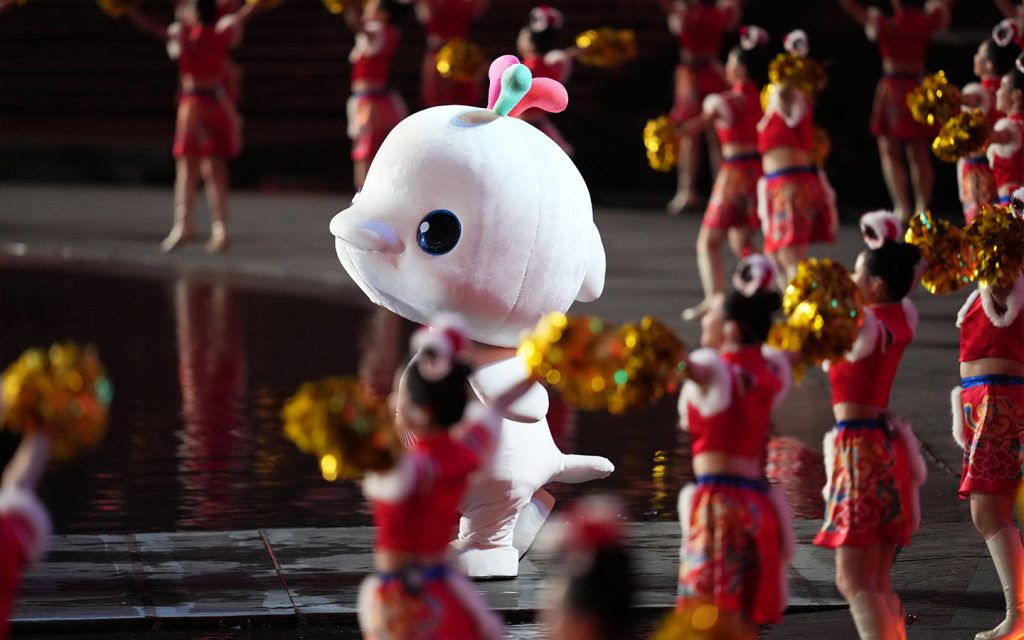
The viral nickname “Greater Bay Chick” reflects how audiences reinterpret official imagery through everyday cultural references. Some observers noted that the mascots’ rounded form and pale colouring resemble classic Cantonese chicken dishes, an association that helped the meme gain traction.
What is notable is that organisers did not publicly reject the informal label. Instead, the broader visibility appears to have reinforced the mascot’s presence both online and offline.
Across Asia, sporting mascots increasingly function as cultural intellectual property, generating sustained retail sales and post-event exhibitions. In this case, authorities have signalled that the Greater Bay Area mascot may continue appearing in promotional and cultural settings beyond the Games themselves.
That trajectory suggests the characters are being positioned not merely as event figures, but as visual ambassadors for the region.
Why the Greater Bay Area mascot matters
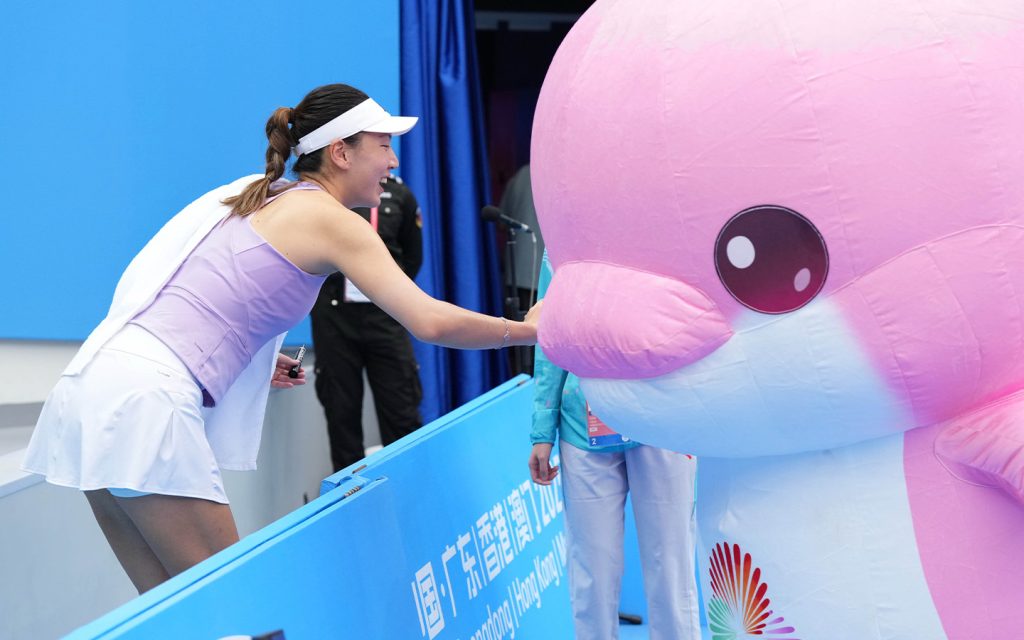
The Greater Bay Area is still shaping its shared identity. It brings together cities with distinct economic profiles and cultural histories, yet seeks to project a unified regional presence internationally.
Large-scale integration initiatives are typically expressed through policy frameworks and economic data. Public familiarity, however, often develops through repeated visual exposure and cultural symbols.
The rise of the “Greater Bay Chicks” illustrates how digital engagement can amplify official branding, transforming a sports mascot into a recognisable regional icon. Whether the characters endure beyond the Games remains uncertain. But their rapid adoption shows how the Greater Bay Area mascot has already entered the region’s visual vocabulary.
In the digital era, even regional integration needs a face, and in the Greater Bay Area, that face now has a pink blush and a nickname.