Across the Greater Bay Area (GBA), some of the most striking buildings in the world have gone up in the past two decades. Their structures are so unconventional in shape that when photographs of them circulate online, some people wonder if they’re real.
Many were designed by globally recognised architects pushing engineering to its limits. Others came from smaller studios handed unusually large mandates. What connects them is an approach that treats the building itself as a statement, not just a structure.
Here are five of the most visually extraordinary buildings in the GBA.
Morpheus Hotel
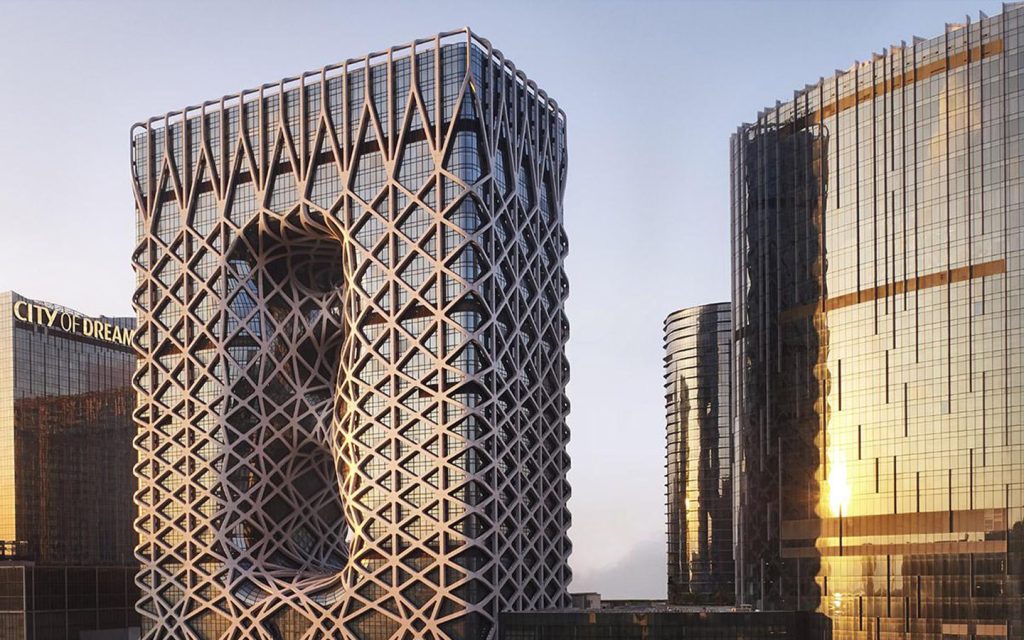
Most luxury hotels in Macao compete on interiors – the chandeliers, the marble, the sheer square footage. The Morpheus, which opened at City of Dreams in June 2018, decided to compete on the outside.
Designed by the late Zaha Hadid, the 40-storey tower is wrapped in a free-form steel exoskeleton, a structural frame on the exterior rather than hidden inside, allowing enormous voids to be carved through the building itself. Those dramatic openings aren’t decorative. They transfer load around the gaps and eliminate the need for internal support columns.
[See more: Major Zaha Hadid Architects exhibition unveiled in Shenzhen]
Hadid drew on the tradition of Chinese jade carving – hollowing solid stone into intricate forms – as a conceptual starting point. It was one of the last major projects designed by her firm before her death in 2016. Against the conventional towers of the Cotai Strip, it still looks like nothing else.
Guangzhou Opera House
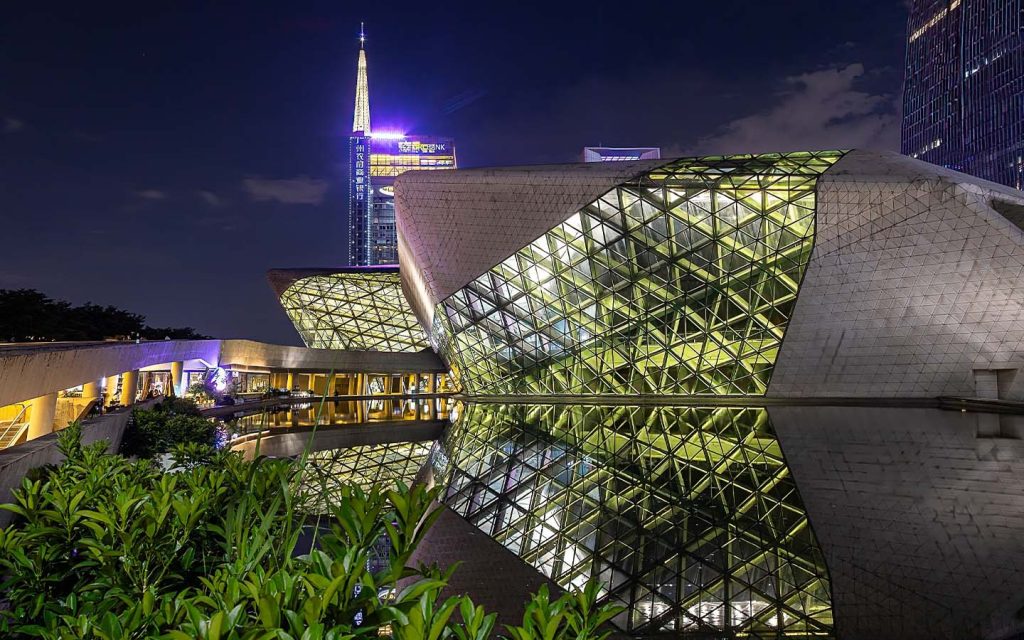
Two angular, stone-like structures sit along the Pearl River waterfront in Guangzhou’s Zhujiang New Town. From certain angles, they look less like a building and more like something the river deposited there over centuries.
That’s more or less what Zaha Hadid intended. The Guangzhou Opera House, which opened on 9 May 2010, was inspired by river pebbles shaped by water erosion – giving it flowing lines, irregular geometry and a faceted surface of sharp angles, glass panels and granite. There’s no conventional symmetry. It reads differently from every angle.
[See more: GBA Voices: Macao architect Christine Choi on doing business in the Greater Bay Area]
Inside, a 1,687-seat opera hall and a 350-seat experimental theatre serve Guangzhou’s cultural calendar. But many visitors arrive without tickets, drawn purely by the silhouette.
Zhuhai Opera House
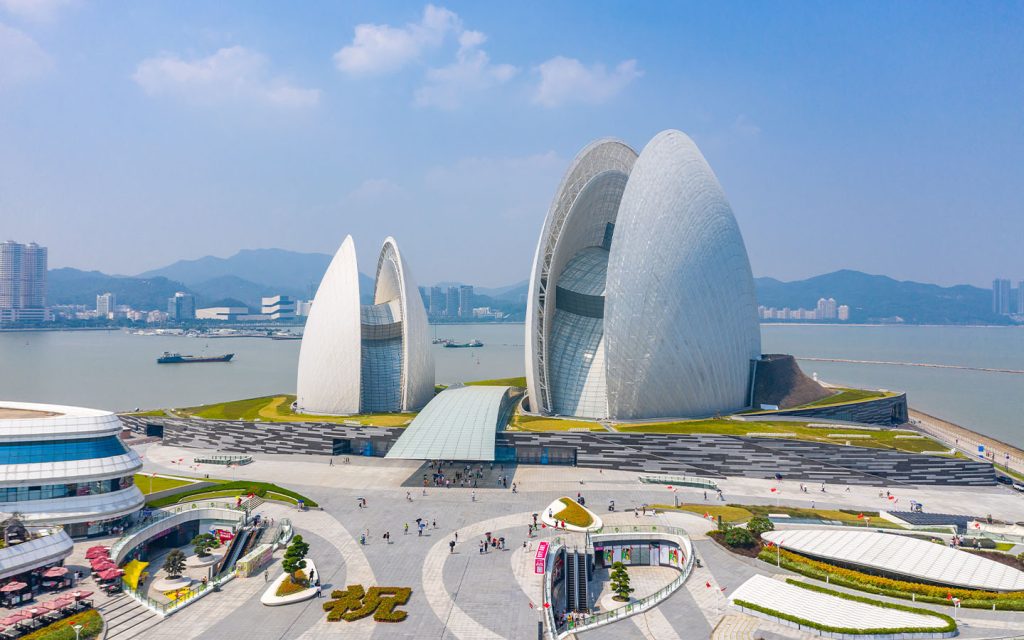
Just off the coast of Zhuhai, two enormous shell-shaped structures rise from Yeli Island – one of the quieter architectural surprises along the Pearl River Delta coastline. Opened in late 2016, the Zhuhai Opera House is a visual marvel.
[See more: Liu Jiakun of China bags the ‘Nobel Prize of architecture’]
The design, by architect Chen Keshi, draws on the form of a local scallop species, giving rise to the twin “Sun and Moon Shells.” The larger shell houses the main theatre, while the smaller contains a secondary performance space. Both sit on the edge of Xiangzhou Bay facing open water. At night, the illuminated structures reflect off the sea below, and the opera house becomes one of Zhuhai’s most photographed landmarks.
Shenzhen Bao’an International Airport Terminal 3
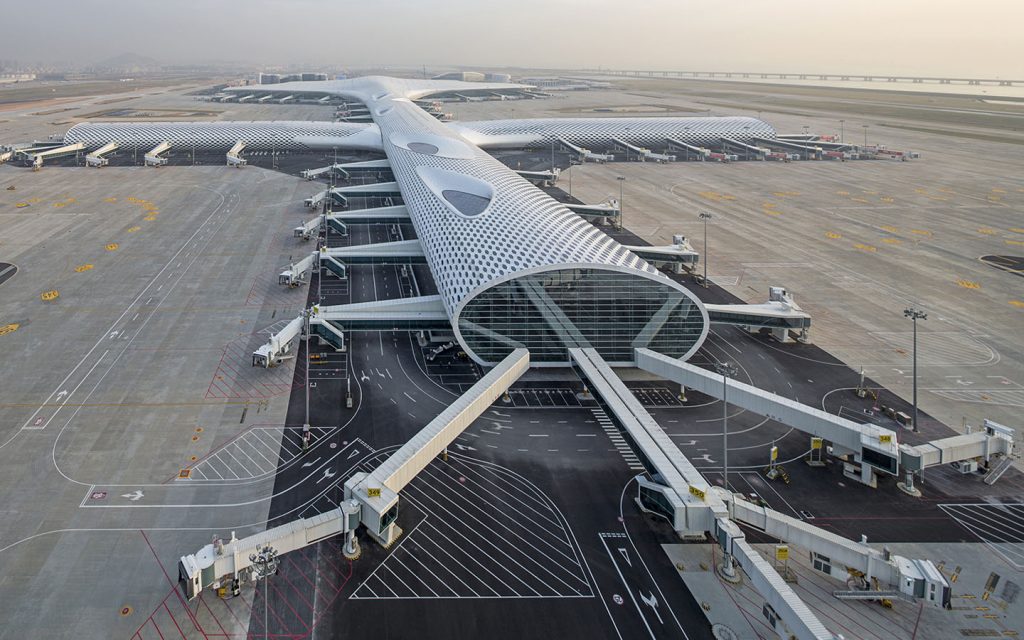
First impressions matter, and Shenzhen clearly thought about the one it would make.
Terminal 3 of Shenzhen Bao’an International Airport opened on 28 November 2013, designed by Italian firm Studio Fuksas. Stretching roughly 1.5 kilometres in length, the terminal’s aerodynamic form is frequently compared to a manta ray in motion. Its defining feature is a double-skin honeycomb facade – thousands of hexagonal perforations filtering natural light into the spaces below, so the interior glows rather than sits under fluorescent strips.
[See more: ‘How was it?’ Hyatt Regency Bangkok Suvarnabhumi Airport]
Inside, sweeping white curves and ribbed structural forms give the terminal the atmosphere of a contemporary arts centre. For Shenzhen, a city that’s truly arrived among the world’s great urban centres, it’s an effective opening statement.
Marisfrolg Pavilion
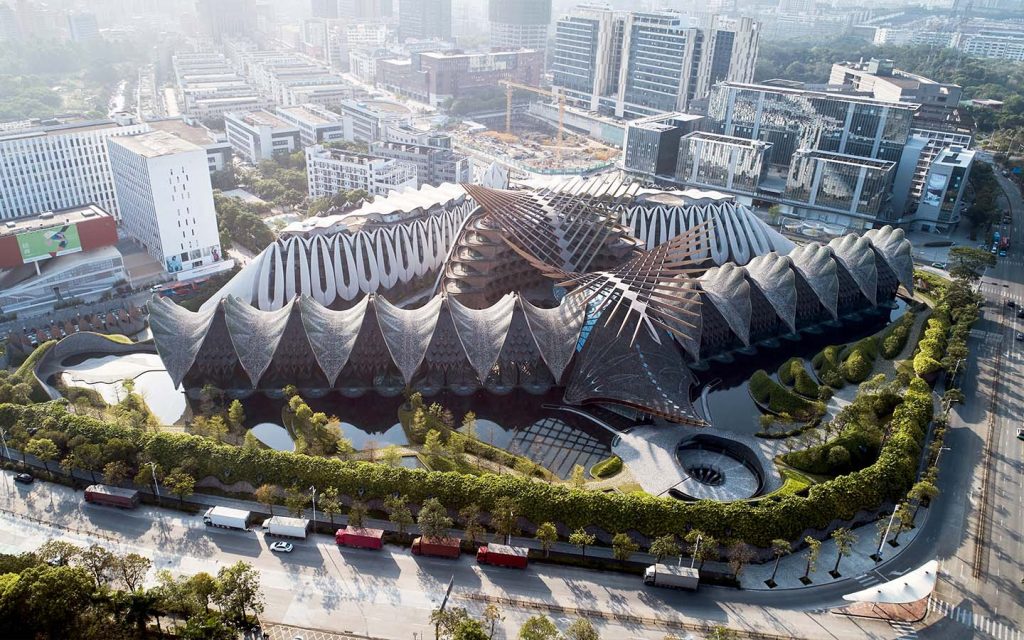
The last entry on this list is also the least famous, and probably the most surprising.
Most corporate headquarters are designed to impress clients and satisfy planning requirements. The Marisfrolg Pavilion in Shenzhen’s Longhua District was apparently designed with neither constraint in mind.
The story starts with Marisfrolg founder Zhu Chongyun, who commissioned New Zealand studio Architecture Van Brandenburg after visiting their offices in Dunedin and Queenstown, reportedly giving them complete creative freedom, and set no fixed budget. Construction began in 2008. It took 15 years.
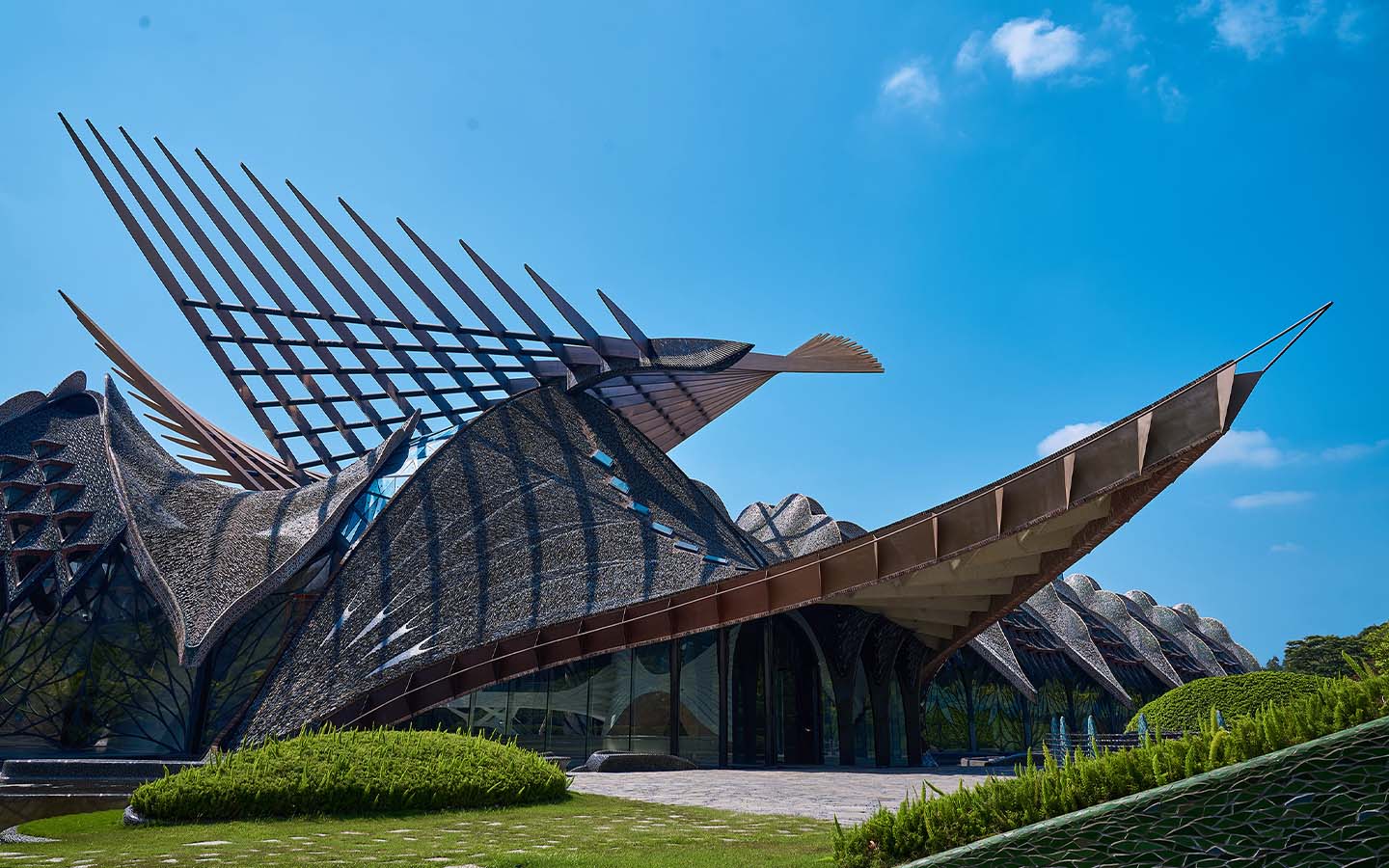
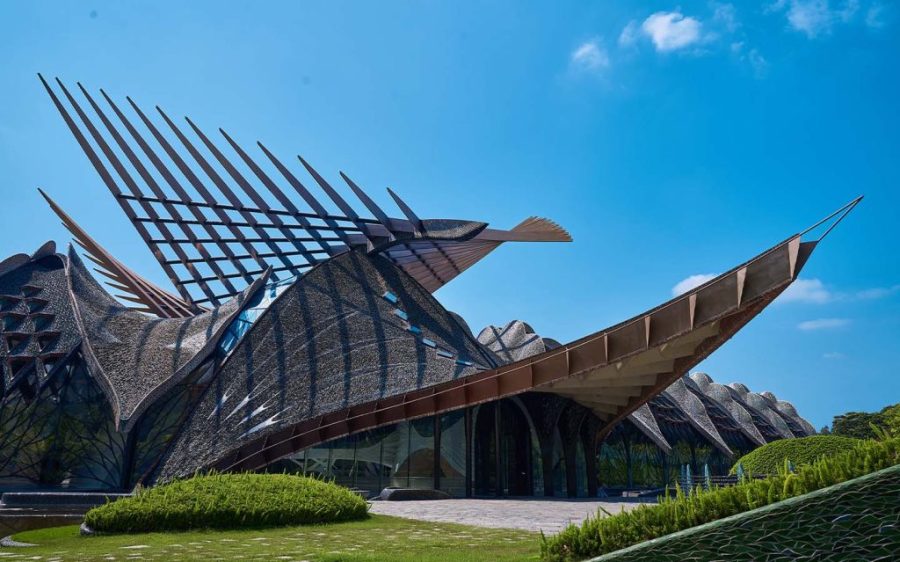
What emerged is a 190,400-square-metre fashion campus – design studios, a boutique hotel, exhibition spaces, restaurants and an 80-metre catwalk – built around a central pavilion whose architecture draws on biomimicry and the naturalist engineering principles of Antoni Gaudí. The Van Brandenburg father-and-son team applied those principles through double-curvature geometry and forms inspired by tropical plants and insect exoskeletons.
[See more: How to see some of Macao’s best modernist architecture in half a day]
Up close, the exterior is covered in a richly textured mosaic of recycled ceramics, marble offcuts, glass slag and reclaimed brick – around 80 percent recycled materials. It doesn’t look like a corporate campus. It looks like something that grew there.
The pavilion has also drawn attention internationally. The project received a Gold Award at the Global Future Design Awards and recognition from the International Design Awards, while its unusual biomorphic design has been discussed in architectural circles since appearing at the Venice Biennale of Architecture.