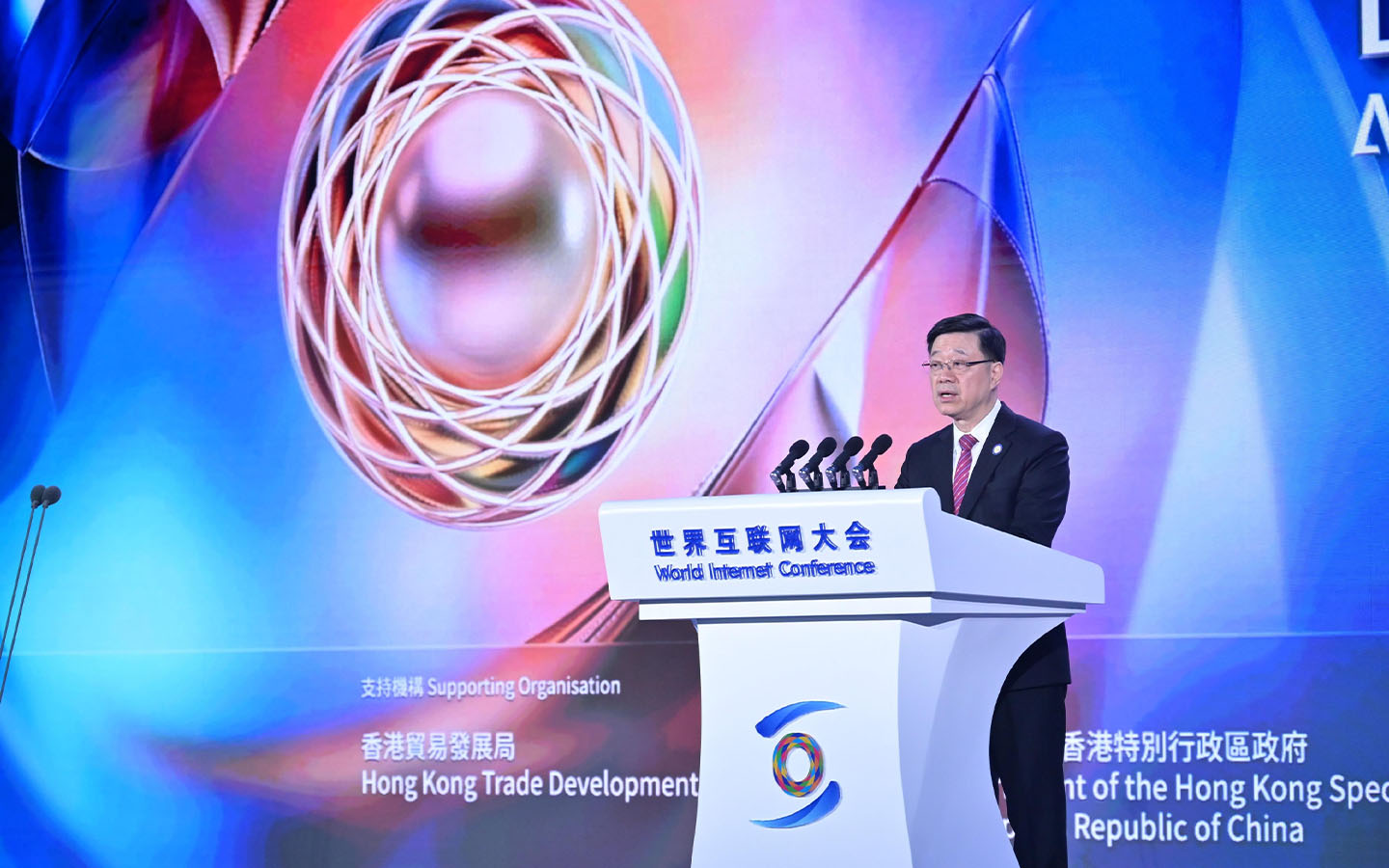
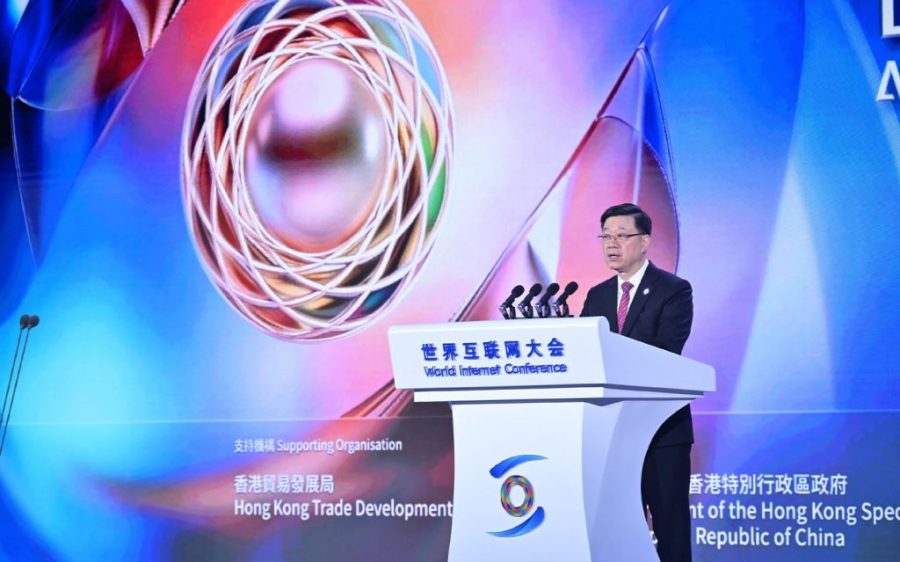
Hong Kong Chief Executive John Lee used his keynote at the World Internet Conference Asia-Pacific Summit on Monday to cast the city as both a testing ground and transmission belt for China’s digital ambitions, arguing that artificial intelligence and cross-border innovation will define its next economic chapter.
Speaking at the Hong Kong Convention and Exhibition Centre in Wan Chai, where more than 1,000 political and business leaders from some 50 countries and regions gathered, Lee said hosting the summit for a second consecutive year underscored the SAR’s “growing prominence” as an international innovation and technology hub.
Lee invoked Hong Kong’s designation in the newly approved National 15th Five-Year Plan as a core international I&T hub. He said the city was a “premier international financial, shipping and trade centre” whose common law system, free flow of information and capital, and connectivity to the mainland and the wider world make it a natural bridge between competing digital ecosystems.
The summit’s theme – “Digital and Intelligent Empowerment for Innovative Development – Jointly Building a Community with a Shared Future in Cyberspace” – also gave Lee a platform to argue that the Asia-Pacific needs a more cohesive digital strategy amid a fast-evolving, and increasingly fragmented, global landscape.
Much of his speech focused on the Greater Bay Area. Lee pointed to the Hetao Shenzhen-Hong Kong Science and Technology Innovation Co-operation Zone, whose Hong Kong Park opened in December, as “a prime example” of integration, offering not just space but “vast opportunities for innovative synergy” with Shenzhen and potential that “radiates beyond boundaries.”
[See more: Chinese University’s new Shenzhen hub aims to boost GBA tech power]
More than 70 tenants in fields from AI and data science to life and health tech had already signed on, he said, while officials are working with Beijing on easing the cross-boundary flow of bio-samples and other “innovation elements.” He also flagged the planned San Tin Technopole, another Northern Metropolis mega-project, as a future “crucial node” linking upstream research to downstream manufacturing in concert with Greater Bay Area supply chains.
On AI, Lee leaned on international rankings to argue that Hong Kong is already punching above its weight. Citing a United Nations report on “inclusive AI for development” and a Global AI Competitiveness Index that places Hong Kong behind only New York and London, he said the government was assembling a “comprehensive strategy” built on infrastructure, R&D and “responsible innovation.”
He said the city’s total computing power has risen to 5,000 petaFLOPS following the launch of Cyberport’s AI Supercomputing Centre in late 2024, and a new data facility cluster at Sandy Ridge is slated to add 180,000 petaFLOPS by 2032 – a 36-fold increase.
Lee also highlighted the InnoHK AI and robotics cluster, which now funds 16 labs and more than a thousand researchers, and previewed the Hong Kong AI Research and Development Institute, due to open later this year, as a vehicle to turn upstream research into commercial applications.