

Researchers in Portugal have uncovered a nest of 150-million-year-old dinosaur eggs that offers new insights into the past, reports the Portuguese news agency Lusa.
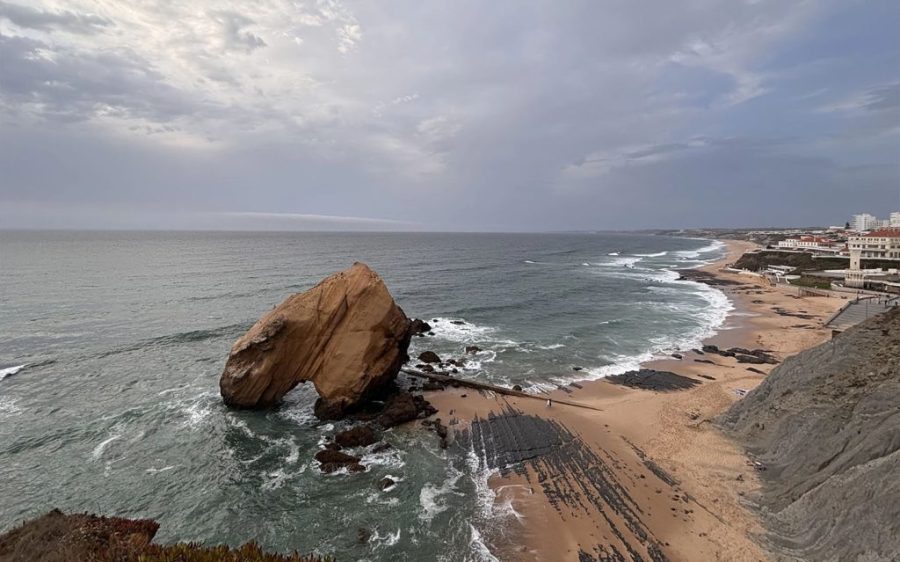
Found on the cliffs of Santa Cruz beach in the municipality of Torres Vedras, the nest of eggs was in sedimentary levels belonging to the Praia de Amoreira-Porto Novo Formation, dated to the Kimmeridgian stage of the Upper Jurassic, about 150 million years ago.
Carlos Natário, an associate researcher at the Center for Research in Paleobiology and Paleoecology (Ci2Paleo) of SHN Torres Vedras, made the discovery during prospecting and monitoring work on paleontological sites in Torres Vedras.
Researchers at Ci2Paleo were surprised by the small size of the nest, containing the remains of 10 eggs according to preliminary estimates, and the grainy sandstone in which it occurred. Such sediment is rare for a nest find and may suggest that the eggs were laid on the bank of a river.
There are also indications that the eggs “could have been semi-buried,” unlike other dinosaur nest fossils that appear to have been on the surface. Preliminary observations suggest this position was intentional, “not the result of accumulation by dragging, as they are found in a certain order.”
[See more: Palaeontologists have uncovered an ancient marine crocodile fossil in Angola]
“It seems clear that almost all the dinosaur hatchlings hatched, as there is a noticeable migration of the shells from the hatching side back into the eggs, with little lateral dispersion of the shells,” Bruno Camilo, director of SHN Torres Vedras and researcher at the Instituto Superior Técnico, told Lusa.
“However, there may be traces of embryos inside the block, as it is not possible to see a section because it is covered with sediment.”
Researchers will proceed with caution in their analysis, utilising new technologies that “allow us to see the imperceptible without resorting to potentially destructive techniques.” The initial phase will involve a computed tomography scan to examine the interior of the eggs and determine if there are any preserved embryonic remains.
According to an Instagram post from SHN Torres Vedras, another Ci2Paleo researcher recently identified a different site in the cliffs of Torres Vedras, around two kilometres south of Santa Cruz beach, with dinosaur eggshells.
Portugal is one of the few places in the world known to have eggs and nests of Upper Jurassic dinosaurs.