
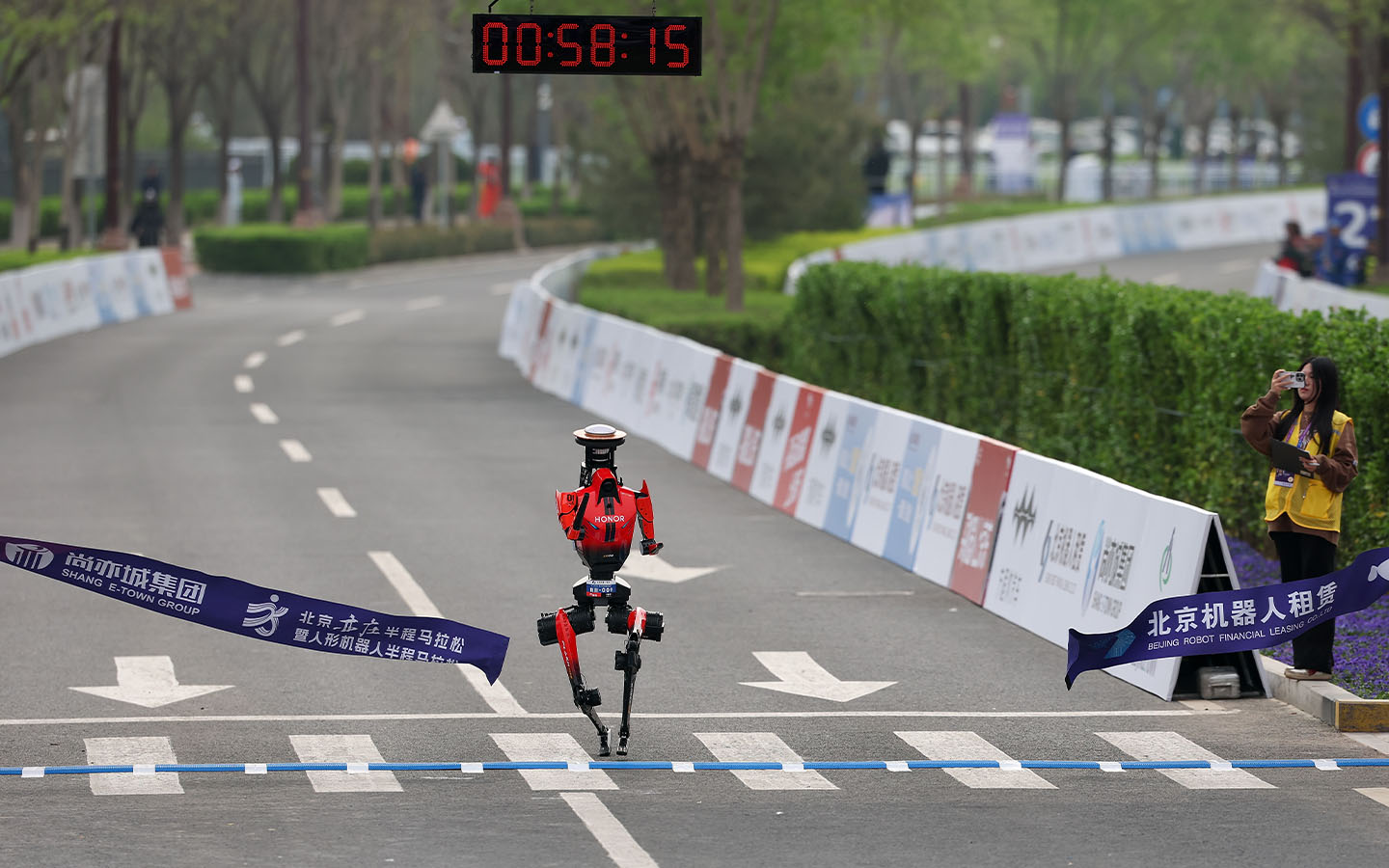
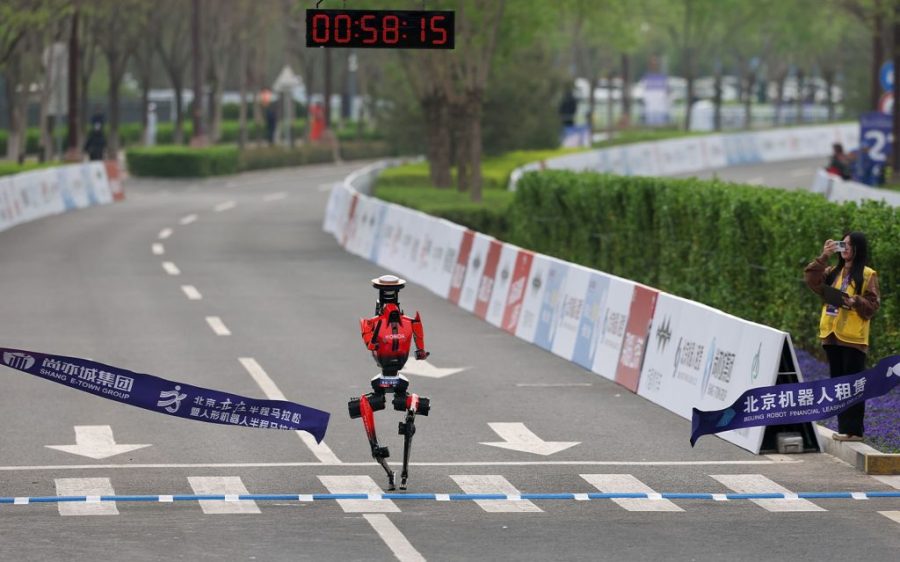
A humanoid robot built by Shenzhen Honor Smart Technology Development Co., Ltd. has won the second Beijing E-Town Humanoid Robot Half-Marathon, outpacing the human world record by nearly seven minutes.
Named “Flash,” the bipedal robot completed the 21-kilometre course in 50 minutes and 26 seconds under autonomous navigation, at an average speed of around 25 km/h. The time beats the men’s human world record of 57 minutes and 20 seconds, set by Uganda’s Jacob Kiplimo at the Lisbon Half Marathon in Portugal last month.
Under the event’s weighted scoring rules, Flash was awarded the championship over a remotely-controlled Honor robot that had physically crossed the line first in 48 minutes and 19 seconds. Remote-controlled robots have their finishing times multiplied by a coefficient of 1.2 to encourage the development of autonomous navigation.
As the event’s organisers explained, autonomous navigation “represents a technological foundation for humanoid robots to be applied in more scenarios in our daily life towards the future.” The two autonomous runners-up were also from Honor, finishing in around 51 and 53 minutes, respectively.
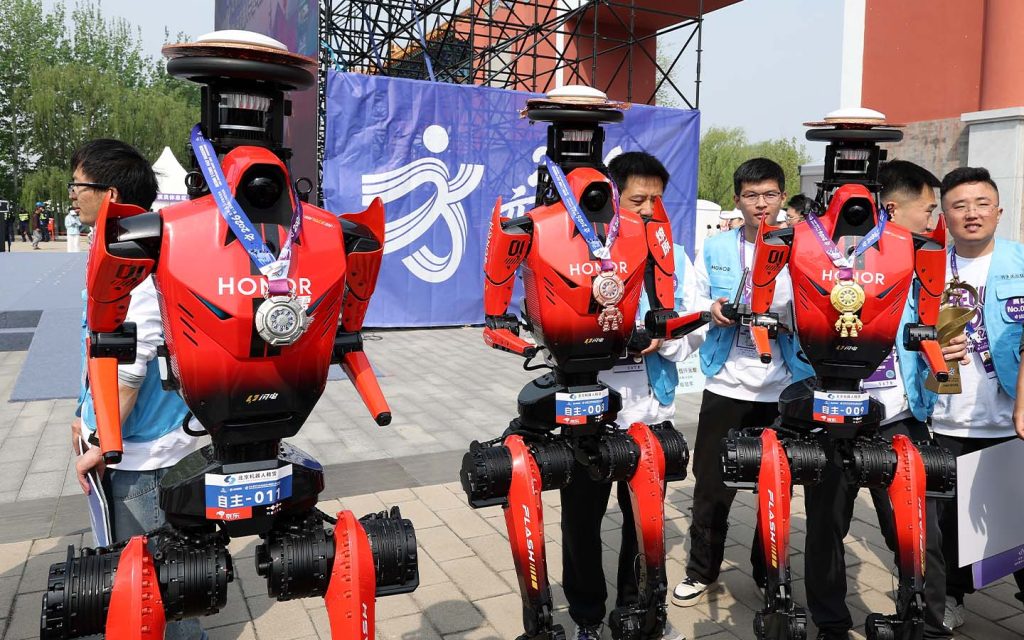
Honor’s test development engineer Du Xiaodi said the robot was modelled on elite human athletes, with legs approximately 95 cm long and a powerful liquid-cooling system largely developed in-house, with potential applications in future industrial scenarios. Team captain Ma Huaze said the biggest challenge was “having the courage to perform and test large-scale upgrades on a major competitive stage like this.”
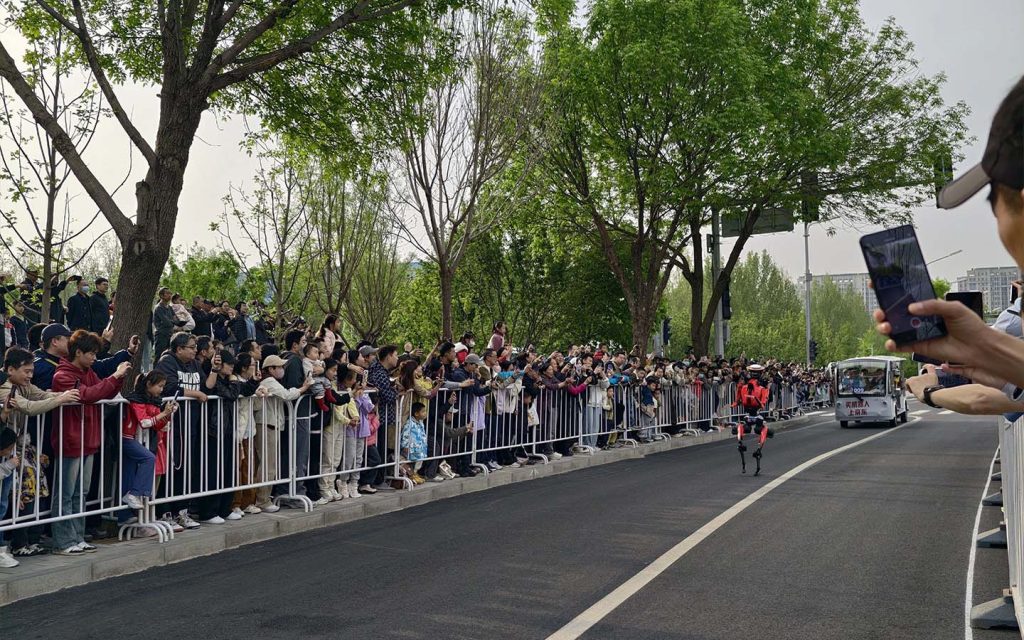
The result marks a dramatic leap forward from the inaugural event in 2025, when the winning robot – Tiangong Ultra – took 2 hours, 40 minutes and 42 seconds, and only six of the 20 competing teams managed to finish at all. This year, over 100 teams took part, including participants from Germany, France and Brazil, and at least four robots clocked sub-one-hour times. Robots and human runners followed the same route but in separate lanes, with a robot cutoff time of three hours and 40 minutes.
[See more: Shenzhen phonemaker Honor will unveil a humanoid robot at MWC Barcelona]
The race was not without its moments of drama. One robot fell flat about 200 feet from the starting line and continued the race with its upper body held together with packing tape. Another crossed the finish line, then promptly veered off course and fell into a bush. Flash itself crashed into a railing near the end, but was helped back up and made a dramatic finish. A separate robot was deployed as a traffic officer on the course, directing participants with arm gestures and voice commands.
Spectators were struck by the pace of change. “I feel enormous changes this year,” said Sun Zhigang, who attended last year’s race and returned with his son. “It’s the first time robots have surpassed humans, and that’s something I never imagined.” Not all reactions were uncomplicated. One young spectator said she was enthusiastic but admitted to being “a little worried” that technology advancing so fast “might start affecting people’s jobs.”
[See more: Shenzhen phonemaker Honor will unveil a humanoid robot at MWC Barcelona]
On the human side of the event, China’s Zhao Haijie won the men’s race in 1:07:47, with compatriot Wang Qiaoxia taking the women’s title in 1:18:06.
The event reflects China’s broader push in robotics. Investment in robotics and embodied AI reached 73.5 billion yuan ($10.8 billion) in China in 2025, and Beijing’s 2026-2030 five-year plan specifically targets the acceleration of humanoid robots as a national strategic priority.