
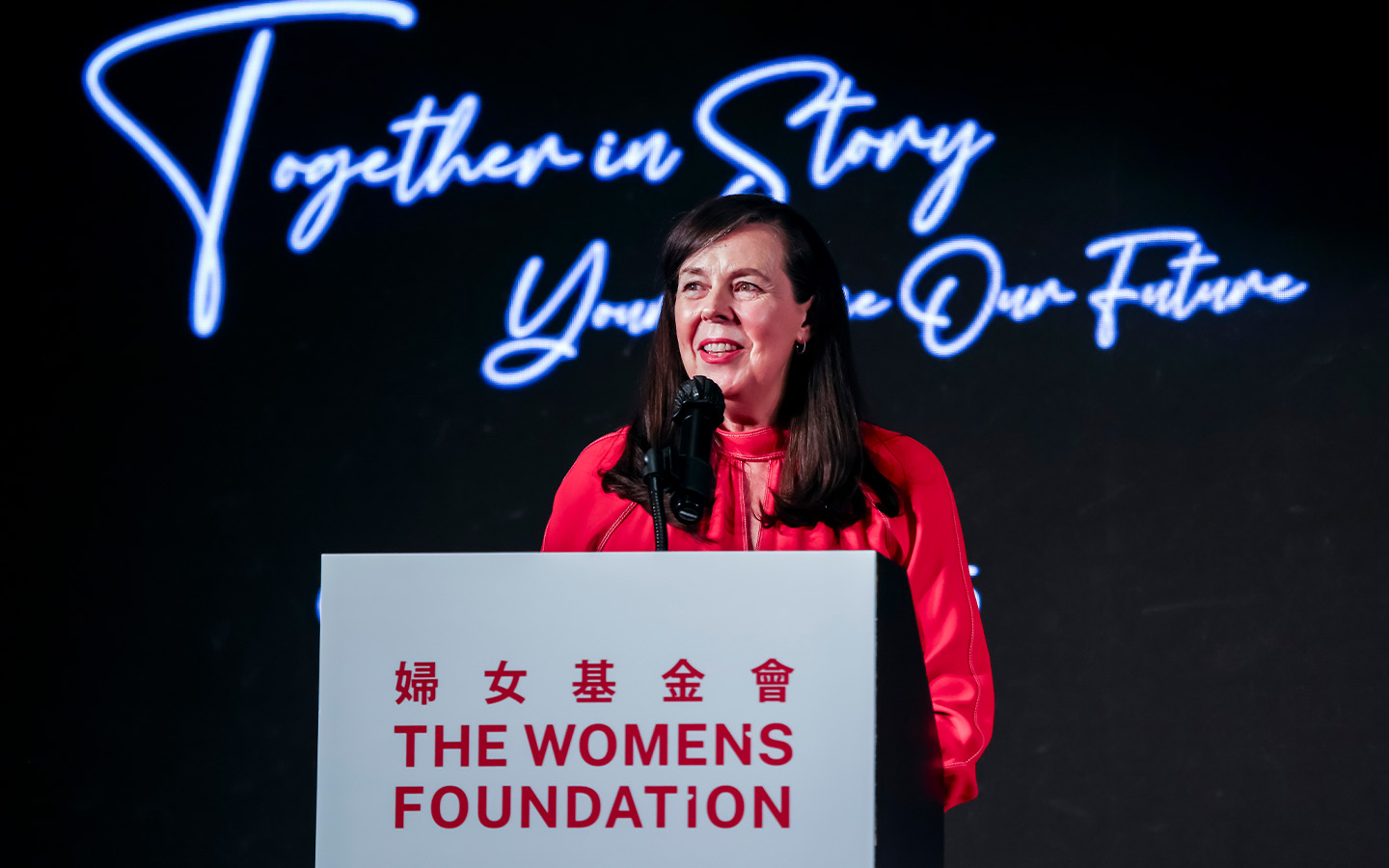
For Fiona Nott, progress rarely moves in a straight line.
There are long stretches when the numbers barely budge and age-old misconceptions gain fresh oxygen – when it feels like one step forward, three steps back. And then, after years of persistence, “you’ll have a pivot moment,” she says.
Nott has seen those moments firsthand. Since 2017, she has led The Women’s Foundation, a Hong Kong nonprofit focused on advancing gender equality through research, advocacy and community programmes. Founded in 2004, the organisation has reached tens of thousands of students, teachers and families, while its mentoring and allyship initiatives have grown into supportive networks across the city.
[See more: GBA Voices: How Hong Kong entrepreneur Ashley Dudarenok learned to decode China]
Over the past two decades, Nott’s career has taken her from social equality work to corporate law to Hong Kong’s nonprofit sector, where she says it’s essential to take the long view.
“In this space, you’ve got to be persistent and have a strong North Star,” she says. “For me, that is the belief that change is possible. If you look at progress over a number of years, change does happen. And when it does, it’s completely energising and fuels our passion to keep going.”
Early questions about fairness
Nott’s interest in equality began early. Growing up between Sydney and London, she noticed the traditional gender roles in her own family and all around her – fathers working, mothers staying home – and began questioning why those expectations seemed so fixed.
An avid reader who imagined becoming an author or archaeologist, she carried that curiosity about the world with her into law school at the University of Sydney, where she became involved in student politics and social equality issues.
After graduating, she worked with Justice Michael Kirby, then president of the Court of Appeal in New South Wales and later a Justice of the High Court of Australia.
“Justice Michael Kirby ist a giant of intellectual thought on social equality issues,” she says. “I learned so much from him, especially that everyone has the capacity to contribute meaningfully to society and make change.”
[See more: Opinion: On International Women’s Day, here’s why being a transwoman in the GBA is far better than you think]
During those early years, Nott also began to see how the law could help shape people’s livelihoods and opportunities.
She recalls cases in Australia involving financial abuse within marriages, where women were pressured into signing loan guarantees or having debts taken out in their names, putting them at risk of losing their homes or damaging their credit.
“Judgments can evolve society,” she says, recalling how Kirby contributed to rulings that strengthened protections for victims in these situations.
Even today, she says, her legal training informs how she approaches nonprofit work.
“The law, in its broader sense, is so powerful,” she says. “I probably draw on my study of the law more today than in other parts of my career, because when you’re looking at social issues, it’s how we recommend changes, analyse shifts, and talk about systemic issues.”
The leap to Hong Kong
After working with Kirby, Nott joined an Australian law firm, where she and several female colleagues informally mentored one another.
Encouraged by that group, Nott asked her managing partner for an overseas secondment. She was nervous about making the request and worried the conversation had gone badly.
But a week later, she received a call: Could she move to Hong Kong in three days? It was an easy yes.
Nott arrived in Hong Kong for a temporary role at a major telecoms firm and eventually stayed on, building a successful corporate career that culminated in her role as company secretary and senior group legal adviser.
Over time, though, she felt pulled back toward the social empowerment work that had first drawn her to law.
In 2003, she left the corporate world to help establish the Hong Kong chapter of Room to Read, a nonprofit focused on literacy and girls’ education. Soon after, she moved to New Delhi for 15 months to help set up the organisation’s Asia programme office.
The experience deepened her understanding of how social change evolves, particularly around girls’ access to education, and strengthened her resolve.
When she returned to Hong Kong, Nott began looking for ways to engage with local issues. That search eventually led her to The Women’s Foundation.
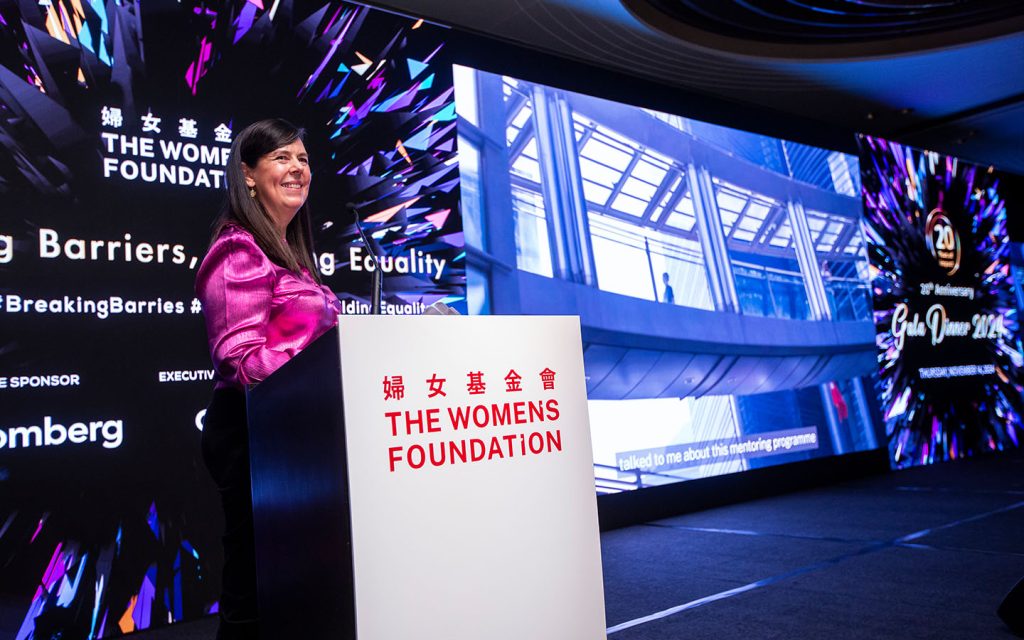
Finding The Women’s Foundation
Nott first became involved through the foundation’s work on corporate governance and women on boards – an area where her legal background proved valuable.
“I’m passionate about gender equality and corporate governance, so it was right up my alley,” she says.
When she became CEO in 2017, she set out to bridge the gap between social issues and corporate decision-making.
“At the time, the priority for me – and that continues today – was to connect the dots and bring more of the social issues to the business community,” she says.
That meant highlighting topics often overlooked or considered taboo, from sexual violence to the structural barriers affecting women’s economic participation, while continuing to push for board diversity and greater male allyship.
These issues remain significant today. Approximately one in three women in Hong Kong report experiencing sexual violence. On average, women in Hong Kong still earn about 21 percent less than men, and women’s labour participation still lags behind, at about 42 percent for married women compared with roughly 61 percent for married men, mainly owing to home and caretaking responsibilities.
Guided by data
Research plays a central role in deciding what to prioritise, when to pivot, and when to celebrate.
As an example, she points to a study published in 2021, where The Women’s Foundation examined how male university students in Hong Kong view gender equality. While many supported equality in principle, about 75 percent still held relatively conservative views about gender roles in practice.
For Nott, the findings revealed a gap between concepts and reality – and a need to start engaging with men earlier. The research helped inspire the foundation’s Young Allies programme, which encourages university students to learn about gender equality and inclusivity through mentorship and hands-on experiences.
[See more: GBA Voices: Macao architect Christine Choi on doing business in the Greater Bay Area]
Other research has highlighted more encouraging signs. A 2025 report by Women Chief Executives Hong Kong, KPMG, and The Women’s Foundation found that women now hold 45 percent of senior leadership roles and 37 percent of board director positions in Hong Kong’s financial services sector – both double-digit increases since 2018.
“The financial sector is really leading the way,” she says. “The power of visibility is the key thing. More visible women leaders produce more visible women leaders.”
The long game
Still, Nott knows progress can take years.
Women’s representation on corporate boards in Hong Kong offers one example. For a long time, the numbers seemed stubbornly stuck.
“There was a point there where we were hovering around 13 percent for years,” she says. “We couldn’t get traction.”
Now, the landscape is shifting. In 2022, the Hong Kong Exchanges and Clearing banned single-gender boards, giving listed companies until 2024 to make changes.
“That certainly has been one for the long term. But we just kept going,” she says. “We kept encouraging each other and having those conversations.”
Looking ahead, Nott says the foundation will continue its existing initiatives, such as empowering secondary school students through STEM, a boardroom and C-suite leadership programme, mentorship, and allyship.
[See more: International Women’s Day: Celebrating Macao’s unsung heroes]
It has also recently launched Path to Empowerment, a new programme focusing on emotional resilience and life skills for women from underprivileged backgrounds – many of whom have been unable to enter or stay in the workforce due to childcare and caregiving responsibilities – with an aim to help them improve their quality of life.
Ultimately, she believes lasting change depends on enduring persistence and communities working together.
“We can’t do it alone as an organisation,” she says. “It’s really an ecosystem. Our programme participants, our mentors, our allies … we all play a role. You keep doing the work, keep doing the work, and then, boom – change happens.”