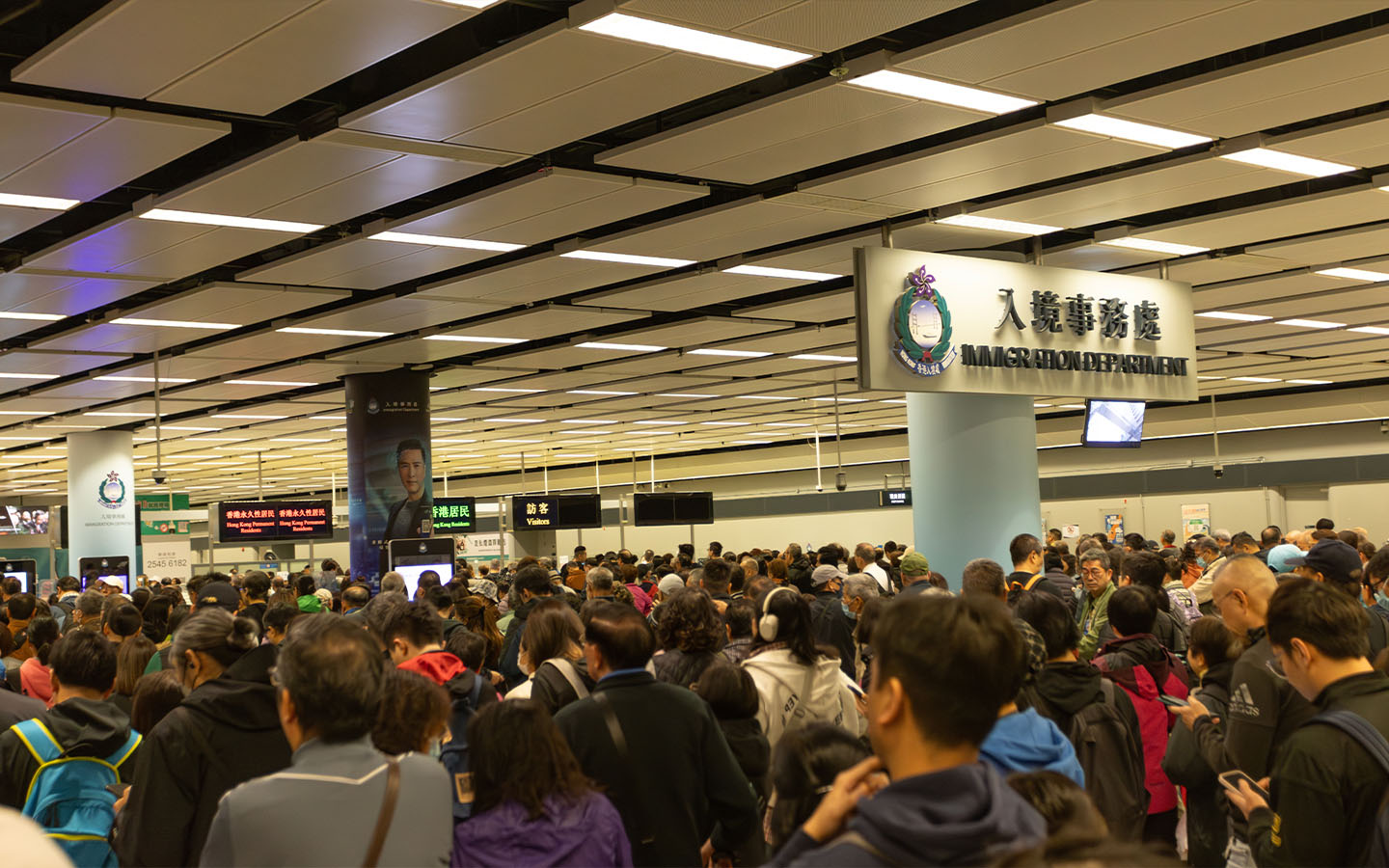
Hong Kong’s checkpoints are set to come under intense pressure over the Lunar New Year, with authorities forecasting 11.38 million arrivals and departures between Saturday and 23 February, the SAR’s public broadcaster RTHK reports.
The vast majority of travellers – about 9.52 million – are expected to pass through land checkpoints. Officials from Hong Kong’s Immigration Department have warned that congestion would be most severe at the likes of Lo Wu, the Lok Ma Chau Spur Line and Shenzhen Bay, where average daily passenger flows are projected at around 200,000, 187,000 and 156,000 respectively.
The department expects the busiest outbound day to fall on Saturday – the day before Lunar New Year officially kicks off for mainland Chinese – when departures could reach about 636,000. The return rush is likely to peak on 22 February, with around 663,000 arrivals.
All checkpoints will operate on their normal schedules throughout the holiday, with the Lok Ma Chau/Huanggang crossing and the Hong Kong-Zhuhai-Macao Bridge port continuing their round-the-clock operations. Additional manpower will be deployed at border facilities to help manage the surge, including extra security staff.
[See more: Travel across the GBA surges in the first week of the Lunar New Year travel rush]
A joint command centre involving police, the Customs and Excise Department, and the MTR Corporation will be set up at Lo Wu coordinating real-time responses to congestion.
Travellers have been urged to plan ahead and avoid peak travel days where possible. Authorities pointed Hong Kong residents to the Easy Boundary online platform, which offers live information on conditions, including estimated waiting times for pedestrians, private vehicles and cross-boundary shuttle buses.
This year’s Lunar New Year travel rush, considered to be one of the largest yearly human migrations, will run from 2 February to 13 March.