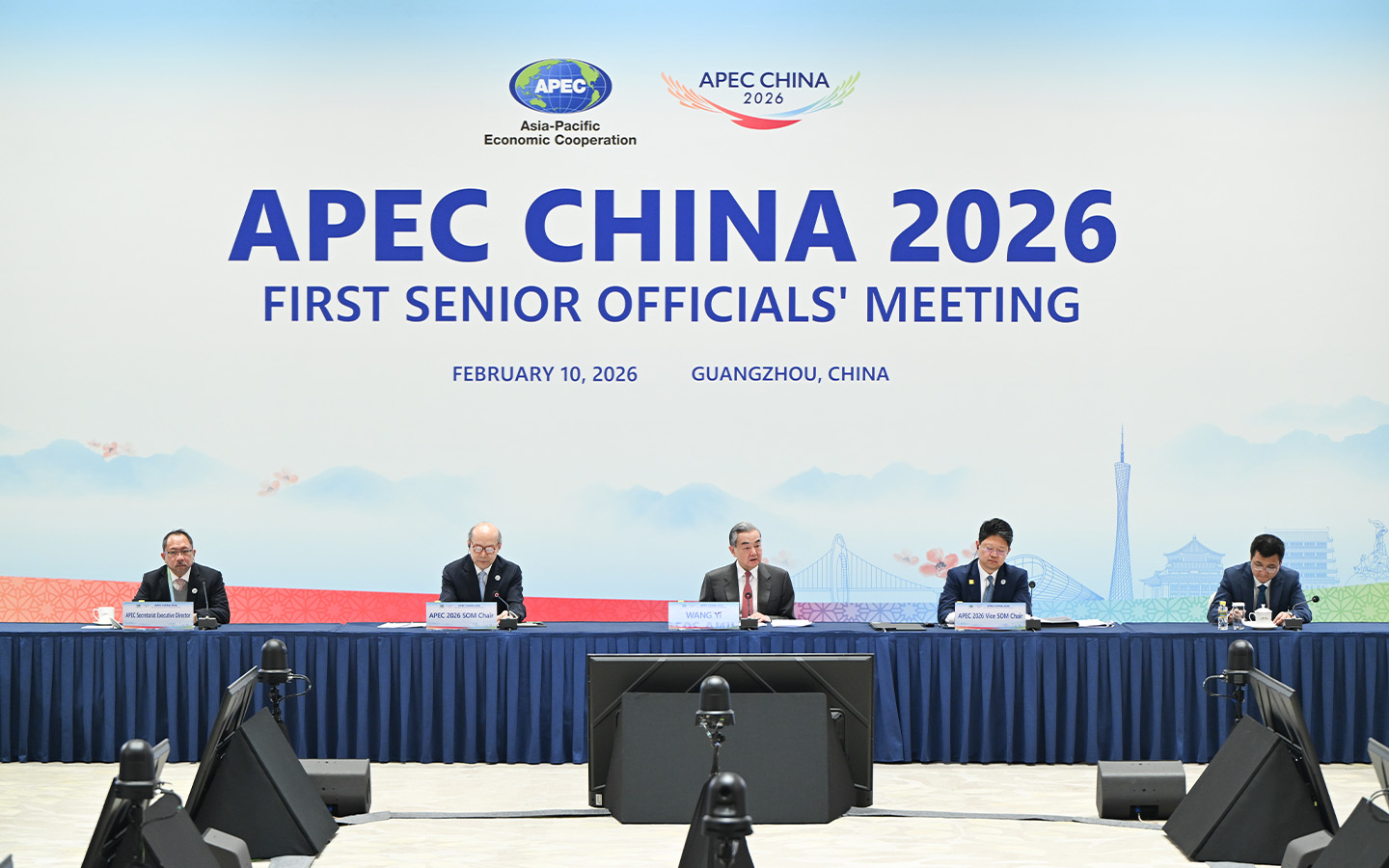
Senior officials from Asia-Pacific Economic Cooperation (APEC) economies convened in Guangzhou on Tuesday for the first Senior Officials’ Meeting of APEC 2026, with China’s Foreign Minister Wang Yi using the opening session to press for deeper regional economic integration and progress toward an Asia-Pacific Free Trade Area amid a period of global “turbulence.”
He urged APEC members to focus on producing a concrete and forward-looking outcome document to be adopted at the leaders’ meeting later this year, framing it as a key task of China’s year as host.
Wang noted that China had decided on “Building an Asia-Pacific Community to Prosper Together” as 2026’s theme. On the question of where APEC should be heading, he cited President Xi Jinping’s vision of championing open development “where everyone shares opportunities and emerges a winner” through inclusive economic globalisation.
[See more: Greater Bay Area emerging as Asia-Pacific’s next nexus of growth, says top economist]
The foreign minister also highlighted digital, smart and green transformation as new growth drivers for the region, calling for stronger cooperation in areas such as digital economy development, innovation and low-carbon transition to support sustainable growth across APEC economies.
At the same time, Wang said cooperation should take account of differing development levels and diversity within the bloc, and called for expanded practical collaboration in development-related governance fields, including areas such as trade facilitation, infrastructure, technology and people-to-people exchanges.
The Guangzhou meeting marks the third time China has hosted APEC, and the first since 2014. Wang linked the 2026 host year to the opening of China’s 15th Five-Year Plan period, saying Beijing would seek to deliver new opportunities to the region through further opening-up and domestic reform.
[See more: China ready to work with all on Global Development Initiative: Premier Li Qiang]
He also listed highlights of the past 12 years, such as the Regional Comprehensive Economic Partnership (RCEP), the Comprehensive and Progressive Agreement for Trans-Pacific Partnership (CPTPP), and the Digital Economy Partnership Agreement (DEPA) coming into force, and internet penetration rates climbing from 52 percent to nearly 90 percent across the region.
Stumbling blocks, he noted, included the Covid-19 pandemic and the subsequent rise of unilateralism and protectionism – which had ushered in a “new period of turbulence and transformation.” As such, Wang emphasised the “significant responsibilities” of hosting APEC at this time. Referencing Lunar New Year, just days away, the foreign minister said he looked forward to seeing APEC charge ahead “like a galloping horse toward the goal of an Asia-Pacific community.”
The Senior Officials’ Meeting is the first in a series of APEC gatherings this year and is intended to lay the groundwork for consensus-building ahead of the APEC Economic Leaders’ Meeting scheduled for November.